In and of itself, my dad’s death was hardly remarkable. And yet it was breathtaking. It was the everyday sunset. A lifetime’s expectation.
Dad was 80 when he died. An old man. He’d been one of the lucky ones of his generation. One of the ones who’d lived to old age.
At 18 he’d enlisted with the Marines. His older brother was already fighting in North Africa. His older sister was in Europe with the WACs. Two weeks before Dad was to leave, his father was killed in a highway accident. Dad spent those next two weeks hunting, trying to fill the freezer as much as possible for his mother who was now alone to raise five younger children.
Two weeks after his dad’s death, he headed off to basic training in Honolulu, and then shipped out to battles in the South Pacific. During the course of the next three years Dad participated in five assault landings. He was a radioman. Always in the first wave of Marines hitting the beaches. Guadalcanal. Guam. The Marianas Islands. The Marshall Islands. Okinawa.
He returned a battle-weary 21-year-old man. He went to college. Then to seminary. He married Mom. Had Jim and Deb. Was ordained as a Lutheran pastor. Then had Jude and me. He preached. Wrote books. Spoke to groups. Taught. Led. Counseled. Ministered.
All four of us kids went with Mom to the funeral home that day. There were decisions to be made. Too many decisions. Did we want a burial, or cremation? Was there to be a viewing? Open, or private just for family? What kind of bulletins? What kinds of flowers for the service? Did we want this? What about that?
We knew Dad wasn’t there anymore. And he wouldn’t have cared at all about his funeral arrangements. We tried to go with what was most comforting to Mom. She, too, knew that Dad wouldn’t have cared one way or the other.
Then the topic of his military service came up. The funeral director informed us that the Marines would be present at the funeral if we wanted them. She would call and notify them of the time and location of the service.
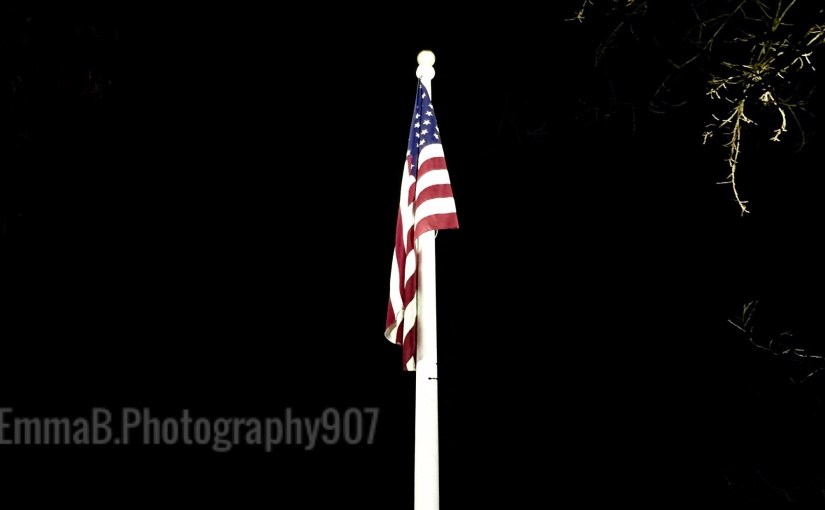
I have quite a few memories of Dad’s funeral. But the one that always bids the tears to come is the memory of the Marines. The single bugler in the back of the church playing Taps while the others, in dress uniform, begin the folding ceremony up front. Then, holding the perfectly triangular flag, one marine approaches Mom. With crisp precision he drops to one knee and presents her with the flag.
“On behalf of a grateful nation,” he says, looking in her eyes.
He said more. But I didn’t hear it. I stopped hearing after those first six words. On behalf of a grateful nation.
How many young boys, and old men, have been buried to those words? How many women, young and old, have been buried to them? Those words are an acknowledgement. The testament of recognition, and of loss. It’s the realization of loss which brings the tears whenever I think of it.
A grateful nation. Which has been defended by, and protected with, the lives of thousands of young boys like my dad. A grateful nation. Which has been loved at tremendous personal risk and loss. A grateful nation. For which many of those lucky enough to survive, have fought nightmares and battle scars even into their 80’s and 90’s.
To those boys, and those girls. Those who serve. Our nation is, and will be forever, indebted. We will forever remember. And we will be grateful. To every single one of them. Forever.

 penniesonmypath
Thanks for this story and tribute, Ruth. That is my most vivid memory of Dad’s service as well.
Deb
LikeLiked by 1 person
Thanks Deb.
LikeLike
Beautifully written Ruth as usual. Working at a church, I have attended many funerals. But none are as emotionally draining as the military funerals. I never hear past the “on behalf of a grateful nation” either. But I worry too many take this marvelous sacrifice too lightly.
LikeLiked by 1 person