Just Laugh

            The County Fair was a magical place.  Other weeks of the year it was little more than an overgrown field.  But during those few weeks in August it came to life.  Games of skill and chance.  Fairground food–the one time a year we were sure to get cotton candy.  Tents full of stables temporarily housing all species of farm animals.  Hawkers selling the latest kitchen and farming gadgets.  Competitions for the most artistic presentations of canned goods, baked goods, and grains.  Rows and rows of cars in the “parking lot” of flattened, tall, dry grass.  

            Everybody came to the Fair.  And those who didn’t, wished they could.  It was the place to be during those couple weeks in August.  From the noise of the engines which powered the rides, the bleating and mooing of farm animals, fast-talking auctioneers and game barkers.  To the smells of the pens, the sizzling hot dogs, and the smoke and grease from the rides.  For me, the Fair was a complete sensory overload.  And I loved it.

            Each year I’d walk through the fairgrounds looking at ribbons on animal pens, watching and listening to the auctioneers.  I’d gobble up a hot dog and take my time savoring the cotton candy.  I’d play as many games as I could, and usually bring home at least one small prize.  But there was one thing that always plagued me.  One thing that year after year kept my Fair experience from being perfect.  The scary rides.

            There was the giant Ferris wheel, that whisked its riders up into the sky, higher than anything else around, and held them there—narrowly escaping certain death.  Suspended by nothing more than a rickety, wooden frame.  

            The Hammer, which threw its riders violently back and forth, as its name suggests.  

            The Tilt-a-Wheel, which spun its riders around in a circle, then rose up off the ground like a giant spinning elevator until the centrifugal force was powerful enough to pin the riders against the outer edge of the ride. Then the bottom fell out, suspending the riders seemingly in space 

            There was the one that looked like a giant black widow spider, which must have really scared me because I have no idea what that ride actually did. 

            And there was the Scrambler.

            The Scrambler was silver and shaped a little like an octopus.  Those brave enough to ride the Scrambler got strapped into their double bucket seats.  Then the attendant came by and lowered a metal bar across the riders’ laps.  When the ride began the riders were whipped and thrown, spun and twisted in crazy eight patterns, faster and faster until their eyes could no longer register on any one point outside the ride.  They were given up to the ride.  Given up to the lack of perspective, the lack of bearings. And ultimately, given up to the rising nausea.

            I remember watching admiringly those kid who were no bigger than me, staggering off the rides.  They were smiling.  A little queasy maybe.  But brave enough to smile anyway.  They had done something which I couldn’t quite make myself do.  They had tackled the scary rides.  And survived.

            Each year on the long drive to the Fair I would have a conversation in my head.  Telling myself that this was the year.  I was going to do it.  No longer would I remain on the outside looking in.  I was going to bite the bullet.  If those other kids could do it, so could I.  And this was the year.  I could feel it.  This was the year that I would become one of those brave, smiling kids.  

            And each year on the long drive home from the Fair my satisfaction with my Fair experience would be complete but for that one area.  Another year of staying on the outside.  Of letting fear keep me from something I really wanted to tackle.  

            And so was the inner turmoil, the summer I was 11.   My sister Jude, three years older than me, was going on the rides.  Jude was always the brave one.  She had asked Dad for a ticket to ride the Scrambler.  I don’t recall now if Dad had actually asked if I wanted to go, too.  In which case, all that was required of me was to nod.  Or if I actually found my voice and asked for a ticket to join her. I was, after all, 11.  I could do it.  And maybe a little of her bravery would wear off on me.  Maybe I could do it.  Maybe this was going to be the year after all.

            Next thing I knew, Jude and I were climbing up into one of those silver bucket seats.  Willing my fingers to still work, I strapped myself in just like I’d watched her do.  Then I sat there, squinting into the bright afternoon sun.  Heart pounding outside my chest.  

            And now that I’m thinking about it, I wish I could remember how it was that I was able to actually sit with her.  I suppose Dad standing just outside the fence weighed in on her letting her annoying kid sister take up the seat next to her.  

            Regardless of how we got there, she was excited, and I was terrified.  I tried to swallow, just as the attendant came to slam the metal bar down across our laps, locking us in for safety.  Clang.  I was committed.  Again I tried to swallow.  I heard the rumble of the motor start up and knew that any second now my world would change. And please God just let me get through this without throwing up.

            And that’s when it happened.  That’s when Jude leaned over and shouted into my ear.  The secret.

            “If you get scared, just laugh.  It’ll help you not feel so scared anymore.  That’s what I do.”

            I nodded.  Okay.  Just laugh. I could probably manage that.  I mean, assuming I was still breathing, and all. 

            A moment later we were thrust sideways.  And it’s funny, but when you’re standing outside the fence on ground that is comfortingly still, the movements of the Scrambler always appeared fluid and smooth. But when you’re the one who’s strapped into one of its octopus-like tentacles, and your entire world is spinning and thrusting and slipping and flying, those movements are anything but fluid and smooth.  They are abrupt and fitful.

            Ten seconds into the ride my eyes gave up.  I caught one brief sighting of Dad and felt safer for just an instant.  But then everything else, everything outside of our bucket seat, became a blur.  My eyes could no longer focus.  I lost my bearings.  My perspective.  I was being violently thrown in directions my body could no longer anticipate.  I was strapped to the end of an eggbeater for crying out loud.  The fear rose up in my chest.  Followed immediately by the nausea.  

Jude elbowed me then.  I turned, swallowing my lunch back down, and looked at her.  She was smiling.  And laughing.  

            Oh yeah.  Just laugh.  

            Haha.  I forced a hollow laugh.  Haha.  Come on. You can do this.  You have the secret now.  So laugh.  Haha. Again we were flung sideways, and then forward, to the other side, and then back, twisting and turning in a blurred world. Hahaha.  I gave in to it.  Gave in to the lack of perspective.  Gave in to the lack of bearings.  I just had to relax and go with it.  And laugh. Hahaha.

            Next thing I knew the ride was ending.  And I was still laughing.  For real. The attendant came and lifted the metal bar with another clang.  I awkwardly climbed out of the bucket seat, and found it difficult to walk straight on rubbery legs.  I staggered after my sister, the brave one, back out through the fence.  I was wobbly.  But that was okay.  Because I was finally one of those kids.  One of those smiling, brave, kids.

            That summer, the year I was 11, the long ride home from the Fair was different for me.  There was nothing left undone.  Nothing which detracted from my full satisfaction with the day.  My experience of the Fair that year was complete.  I had ridden a scary ride.  

            But what I didn’t realize that day was that I’d been given a secret to surviving far bigger things than just scary rides at the County Fair.  I’d been given a secret that would be useful time and again throughout life.  When I lose my bearings, and my perspective blurs.  When I can’t figure out and anticipate which direction I’m going to be flung next.  When I have no control and no other options than to just give in to it and ride it out. When there’s nothing I can do but try to relax and go with it.  Knowing that I will probably, at least, survive this.  

            That’s when I return again for just an instant to that silver bucket seat on a hot August afternoon.  With the bar clanging shut across my lap, the fear and the nausea welling up inside of me.  And my sister Jude turning to tell me the secret to survival.  

            “If you get scared, just laugh.  It’ll help.”

            And it still does.

J –  Thanks for always letting me tag along.  R

Incomprehensible

            I saw in the newspaper this morning the obituary of a 17-year-old boy. I didn’t recognize the boy’s picture at first because I hadn’t seen that boy in several years.  But after a moment or two I realized that I knew him.  When he was little he’d gone to Sunday school and Bible camp with our kids.  When he was little he’d been a cutie.  Happy, easy-going, talkative.  Reading his obituary this morning brought a hollow sadness to my day.

            The newspaper account said he died of self-inflicted injuries.  And an even greater wave of sadness and loss washed over me.

            Self-inflicted injuries. Translated:  something in this boy’s life resulted in him feeling so overwhelmed, or sad, or lost, that at a moment in time death appeared to offer the best solution.  And we–his family, his friends, everyone around him–were unable to intervene in time. So he died.  Of self-inflicted injuries.

            My mind has been stuck on this throughout the day.  Partly because in a year full of suicides this one is the most recent.  Partly because it’s almost Christmas time and death this time of the year always seems to hit a little bit harder.  

            I’ve been thinking about the term “self-inflicted,” and I keep coming back to the realization that one way or another most of the injuries I’ve ever endured have been self-inflicted.  In fact, most of the pain of any kind that I have experienced has at some level been self-inflicted.  

            Whether injuries from doing too much, being careless, not taking care of myself, not paying attention, reacting without thinking.  Most of my injuries over the years have been through some action, or inaction, on my part. It’s funny though, no one ever says, “I sprained my ankle.  It was self-inflicted.”  Or, “I broke my arm ice skating.  Self-inflicted.”  

            But I think emotional pain is not unlike physical pain.  Things happen which I may not have any control over.  But I do control my reaction to them.  And often the greater pain comes from my reaction to things than from the original event.  I get angry and say what I don’t mean.  What I know better than to say.  I pull away from people who love me, and whom I love.  I become fearful, and without seeing it, I start letting that fear control my life.  One way or another, it seems like most of my emotional pain has been self-inflicted, too. 

            I’ve always pictured God standing nearby ready to give me a hug and make everything feel better as soon as I’m ready to turn that way.  I’ve never thought of God as somehow withholding comfort from me because, after all, my injuries were self-inflicted.  I think God is actually even more nurturing when my hurts have been at my own hand.  Healing not only the injury but also the guilt, shame, and embarrassment that might come with those injuries.  My problem has always been more that I have to wallow in that pain, and self-pity, for a while before turning to God to comfort me.

            But when it comes to life-ending self-inflicted injuries we, the Church, have often stood in judgment and rigidity instead of offering that same comfort and healing that God offers to us.  We stand off by ourselves shaking our heads and pointing fingers.  

“It’s too bad,” we’ll say.  “If only he hadn’t died.   God can forgive anything if we repent and seek forgiveness.  But when it’s a suicide…”  and our voices will mumble on, bemoaning this latest tragedy.  Because offering legalism and doctrine is easier than offering compassion and comfort.  And isn’t the shame there ours?

            My heart aches this evening for that 17-year-old boy.  I keep swallowing back the tears, imagining the pain that might have resulted in the conclusion he made.  Imagining the fear, the loneliness, the exhaustion that leads one to finally say, “Okay, I give up.”

            My heart aches too for his parents.  His siblings. Those left to grieve, to struggle with comprehending the incomprehensible.   

            And once again I come back to what I know to be true.  My gratitude and faith in a loving God.  Who isn’t far away at all.  Who sees and knows all.  Who feels our pain.  Who walks with us in our loneliness.  Who desires to carry our burdens, particularly those which seem overwhelming. Who beyond all else desires a close relationship with His imperfect kids.  Who has always been quick to comfort and soothe my injuries and pains over the years.  And who I believe greeted this boy with open arms and a kiss on the cheeks a couple days back.  Hugging him and soothing him.  Wiping his tears.  Shushing him and telling him over and over again, “I know.  I know.  It’s okay. It’s okay.  I know.”  

            The very same God who has always been there to kiss my hurts, I believe was there to kiss that boy’s too.  And to welcome him Home.  Because anything else, would be incomprehensible.

Moments of Grace

            There’s another storm hitting tonight.  Seems like we’ve had a lot of storms lately.  Storms with gusts that roar through the trees outside like a jet taking off down the street.  Storms that hit so hard the whole house shudders in response.

            It’s winter.  The time of year for storms.  And we live on a small island in Alaska.  In a community threaded between jagged mountains and the sea.  An area that often sits in the path of fierce storms that blow in off the Pacific.  

            Sometimes I can picture in my mind the storms building to the southeast of us. Something stirs them up out on the ocean.  They start spinning , tripping up on themselves, whipping into a frenzy.  The winds grow fierce.  The waters become violent.  The storm builds, turning in on itself, becoming more and more volatile. And then it hits land.

            The water slaps and pounds at the rock.  The wind tears its way through the trees.  Ripping at roofs, and slamming into windows.  At times it’s so harsh it’s difficult to walk.  Even to stand.  

            When the fury of those storms is finally unleashed it can be so staggering that it feels like you can’t breathe.  That standing out in the force of the storms, facing into the wind, you have to will yourself to breathe.  Always feeling at first like you have no breath.  That your lungs cannot function in the force of the wind.  You squint against the gusts and remind yourself that you can still breathe.  

            We’ve had a lot of other storms lately, too.  Deaths.  Violence. Families ripped apart by drug and alcohol addiction.  Illnesses. Shootings.  War.  Unemployment. Schedules that are too busy. Families that are too busy.  Worries.  Stresses. Fears.  Frustrations.  Sometimes the storms hit so hard that it’s difficult even to breathe.  It’s a struggle just to stay standing.

            One storm has barely blown through and another is already out there building.  Crime, homelessness, intolerance, suicide.  Winding up like a top, whipping itself into a fury, waiting to unleash its rage.  Injustice.  Turmoil. Strife.  The waters pound at the beach, the wind rips and tears at the trees, and we stand there squinting into the worst of it willing ourselves to keep breathing.  Wondering how many more storms there will be.   And how long until the next one hits.

            Not long ago we stood on a beach one night with friends.  The skies were clear.  The night was crisp, and still.  There was a full moon.  And the light from the moon started bouncing and flashing on the water like a hundred little sparklers on the Fourth of July.  We just stood there on the beach, in awe.  Taking everything in.  Admiring the beauty all around us.  The sparkling moonlight on the water.  The snow-dusted mountains in the distance.  The stillness of the night. 

            We watched as a low fog slowly slipped in along a channel, fully shrouding the island behind it.  The air was still, and everything was so reverently quiet that even our occasional comments to each other were whispered so as to not disrupt the stillness.  The sanctity.

            I looked around at our friends who were there with us and thought of all the blessings we have been given.  Our families. Our friends.  Our community.  Our faith.

            There have been a lot of storms lately.  But as I looked around on the beach the other night, I got to thinking that along with all the storms there have also been a lot of moments like this one. 

            Moments of sitting around the kitchen table laughing and visiting with friends.  Moments of snuggling on the couch with our kids, watching a movie we’ve already seen 100 times before.  And moments of just standing on a beach admiring the stillness of a cold, clear, moonlit winter night.  

            And I think maybe I’ve been spending too much time thinking about the storms lately, and not enough time thinking about those other moments.  The moments of peaceful beauty that remind me why it is that we’ve chosen to live on a small island in Alaska, on the edge of the sea.  Moments that make weathering the storms worthwhile.  Moments of such stillness and wonder.  

            And it just might be that if it weren’t for the storms I wouldn’t fully appreciate the beauty of those other moments.  The moments of grace.

Coming To A Standstill

“Outstanding,” is the word I often use in describing our son, John.  At age 15, John is an honor student.  He’s a trombone player, and just recently played his first solo in a concert.  He’s a swimmer and a soccer player.  He’s an avid reader, and loves to write stories.  He draws cartoon strips when he’s bored.  He’s teaching himself to draw Native Alaskan formline design.  He’d like to learn how to carve.  And he will one day.  He’s honest, he tries hard, he’s responsible, and he has a good sense of humor.  He apologizes when he messes up.  He’s a good big brother, and a favored little brother.

And sometimes he says things that bring me to a complete and utter standstill.

In 4thgrade John struggled to learn some of his multiplication facts.  I repeatedly offered my assistance, assuring him that I was actually pretty good at math.  But he wasn’t interested in my help.

“No, that’s okay.  I can do it,” he’d answer.  Then he’d add something patronizing like, “Our teacher says we have to do it a certain way.”

Silently I’d roll my eyes before going back to whatever I had been doing.

One particular evening he had made a lot of mistakes on his 9’s multiplication facts sheet and I just couldn’t take it anymore.  I grabbed a piece of scratch paper and sat down next to him.  I wrote out the a list of 9’s multiplication facts starting with  9 X 0 =, and then 9 X 1 =, all the way to 9 X 10 =.  Then I filled in the answers, showing him how the ones column decreases by 1 with each multiple, and the tens column increases by 1 with each multiple.

When I finished, he sat staring in disbelief.  Then he turned to look at me, wide-eyed and with just a touch of surprise, and said, “Wow, Mom, that’s actually pretty cool.”

I agreed.  Then I gave him a little pep talk about how once he learns his multiplication facts he’ll never have to re-learn them.  They’ll always be the same.

But as I stood up from the table something was nagging at me.   I couldn’t quite put my finger on it.  But there was something in his tone of astonishment that really annoyed me.

Did he really not think that I might just know something he didn’t know?  That there might be something he could learn from me?

Ultimately, I decided to shake it off.  Until last week.

I walked into the house after work the other day and found John sitting in the living room playing on his phone.  I knew he had a project for school that needed to get done.

“John, get off your phone,” I said, hanging up my jacket.

“Oh, I’m just reading something,” he said, not looking up from his phone.

“Um hmm,” I mumbled, putting my keys on the peg by the door.  “Anyway, get off your phone now and get your homework done.”

“Yes, I will,” he said, still not looking up from his phone.  “Pennies on My Path just posted another story, and I was just reading it.”

I stopped in my tracks and turned to look at him.   After a second he added, still without  looking up, “Some of their stories are actually pretty good.”

He was focused on what he was reading and didn’t seem to notice me standing there dumbstruck.  My mind was going 100 miles an hour over now somewhat-familiar territory.

Does he not know I wrote that story?  That all those stories are mine?

After a few minutes he finished what he was reading and gathered his homework to go work on it at the table.  And I headed into the kitchen to start making dinner.

John really is a great kid.  He’s intelligent, he’s kind, he works hard, he’s honest.  He has a good sense of humor.  He really is an outstanding young man.

And yet there are times when he says things that bring me to a complete and utter standstill.

Postscript:  John, if you’re reading this and thinking that there’s a certain familiarity to it, it’s because I WROTE IT!  And by the way,  I pretty well rock my multiplication tables, too!  Love, Mom

The 50 Yard Line

A doctor friend of ours once said that being a doctor in a small town is a little like having a front row seat on the 50 yard line of people’s lives.  He also said that it was a privilege.  He thought the same was probably true for small-town counselors, as well.  That we too have the privilege of a front row seat on the 50 yard line.

I’d gotten a phone call from the hospital that afternoon asking me to stop by later that day and visit a patient who was detoxing from alcohol.  The nurse explained that the patient had said he was willing to speak to me.  I knew the man, though we hadn’t talked for some time.  I said I’d come by.

When I walked into the  hospital room later that afternoon I pulled a chair over to the side of his bed and sat down. I explained that the hospital had called me.  He nodded.

“Yeah, I told her you were the only counselor-type I would talk to,” he said, with a wry smile.

I smiled and said that was pretty high praise.

I asked how he was doing.  He shook his head.

“Oh you know, this stuff is killin’ me.  I can feel my liver givin’ out,” he said.  “Every time I do this it’s a little harder for my body to come back. I’m gonna kill myself with alcohol.”

One of the hardest things I had to learn when I became a counselor was to be quiet.  To be able to sit in silence.  Those first few years I often felt the need to fill the gaps of silence.  It took me a while to understand that those silent gaps are often the most important parts of conversation.

“You know my kid?  He can’t even drive yet.  He’s a good kid.  You know him?”

I said that I knew of him.

“Yeah, he’s a real good kid,” he nodded.  “Not like his old man.”  He snorted a painful laugh.

“I was gettin’ in real bad shape, you know?  Drinkin’ a pint at a time, every hour or two.  I started shakin’.  I was coughin’ up blood.  I barely made it to the bathroom in time to puke blood.  When I came out of the bathroom, I guess he saw some blood by my mouth. He got scared and said he was drivin’ me to the ER.”

I sat by the side of the bed, listening.  He was a couple years older than me, but looked much older.  His eyes were yellow, as was his skin.  His stomach was bloated.  His whole body shook under the hospital sheet.  Every few minutes, he would reach out an unsteady hand and grab a cup of ice chips on the tray next to his bed.

“So he loaded me in the car and drove me here.  Not even old enough to drive yet, and he’s drivin’ his old man to the ER.”

I asked what his plans were once he was discharged from the hospital.  He said he had to get back to work.  He said he just couldn’t do treatment again.  Who would pay his bills and take care of his family while he was in treatment?

I had only recently started supervising the local treatment center. I mentioned that, and said that we could work something out.  He congratulated me on my new position.  I waited. Hoping he was actually thinking about my offer.

After a little while I added that I was worried he was going to die.

He said that he knew that.  There was another long silence.  And he shakily reached for some more ice chips.

Then he whispered, “The thing is, I don’t think I can beat it.  I think it’s gonna beat me.”

I said all the things a counselor says at times like that.  And he already knew everything I said.  He’d already been to treatment a couple times.  I knew that.  He reminded me anyway.

“Doesn’t matter,” I shook my head.  I reminded him that he and I both knew people who are clean and sober today who’ve gone to treatment numerous times.  I reminded him that you never stop trying.  That treatment works.  And he knew that.

He nodded.  “Yeah, I do.”

“And your kids need their dad,” I added quietly.

He nodded again.  And the tears started.

“I’ve been a shitty dad,” he whispered hoarsely.  “Practically killin’ myself right in front of my kids’ eyes. I tell ‘em, ‘Don’t you guys ever drink, ya hear me?’”  He snorted again.  “What a joke, huh?”

I said that he wasn’t a joke.  That he was a good guy.  Who had an addiction that wanted to kill him.  I repeated that I knew treatment worked.  And I wished he’d keep trying.  I promised to do everything I possibly could to assist him in this fight.

“Thanks,” he said, reaching for another ice chip.  “You know that if I do decide to go to treatment I’ll give you call.”

We visited a little longer.

Then he erupted in a violent coughing fit.  He was struggling to breathe.  I stood up to leave when the nurse came in to help him.  He looked over at me one more time, still coughing, and lifted a hand goodbye.

I left the hospital room feeling like I’d failed.  Knowing that it had to be his decision.  Knowing that there was no way I could force him to go to treatment. Knowing that even if he did go to treatment he still may go back to drinking.  Knowing that it is not my responsibility to save people.

I knew all of that.  And I walked out feeling like a failure all the same.

When my work day ended, I drove over to the baseball field to watch our son’s Little League game.  I stood outside the fence by the outfield, away from the other spectators, glad for some time not to have to talk with anyone.  Just watching a baseball game, alone with my thoughts.

Our son’s team won the game, which was unusual.  Their pitcher threw an impressive game.  Strike out after strike out.  Never wavering in his concentration.  A serious look of determination etched in his young face.

And as I watched the boy pitch, I couldn’t help but think of his dad. Shaking in a hospital bed. Coughing up blood.  Probably dying.  From a treatable disease.  And I thought again about how much I hate addiction.

I left the ball field that night with our excited son.  As we drove home we passed the pitcher, trudging down the road, head down, kicking at a rock.

Our son stopped talking about the game for a  second, and turned to look at the other boy.

“He’s the reason we won our game tonight,” our son remarked.  “He sure doesn’t look very happy, though.”

And that was when I remembered where I was.  Front row.  50 yard line.

Kitchen Table

            Our kitchen table is long and narrow.  It has a chair on either end, and two long benches on the sides.  It’s perfect for our family.  And it’s pine.

            When we first saw the table in a furniture store years ago the sales person tried to persuade us to buy the oak.  Oak is more durable.  It won’t mar as easily.  But we liked the look of the pine.  It won’t hold up as well over time, the sales person had cautioned.  It will get flawed easily.  It won’t hold its value.

            Years ago a cousin of mine was showing me around their home.  We walked through the dining room and he pointed to the table, “I did my homework here one time,” he said.  “It marked all the way into the wood.  Boy did I get it for that.”  He lifted the table runner and showed me where his name was etched into the tabletop.  Now in his 20s, it was a funny story.  But the table runner was still carefully set to cover up the name.  For some reason that image has stuck in my memory.

            So we left the furniture store undecided that day.  The oak would hold its value.  It wouldn’t mark easily when busy little bodies climbed around on it. It was sturdier looking.  Still, we liked the pine better.  It was more us.

            The next day we went back.  We bought the pine table.  The sales person reminded us that although it was beautiful now, it wouldn’t hold up quite as well.  It would get marked up.  It wouldn’t hold its value.

            Shortly after we got it home our daughter Kathryn sat down one evening after supper to work on her second grade spelling list.  She worked hard writing and re-writing her spelling list. Spelling didn’t come easily to her back then.  When I finally hustled her off to bed I noticed that the table held the scratch marks of her second-grader printing.  Half a dozen words were etched into the soft pine of the table where she had been working.  For just a moment I felt a pang.  Our brand new kitchen table was already getting marked up.

            Within the next few months little Benson got promoted from the high chair to the big table, and learned how to eat efficiently with a fork.  After each bite he would happily bounce the tongs of his fork into the table at his place.  One night as I wiped up the table after supper I noticed dozens of little holes–evidence of his fork mastery.

            And four-year-old Anna, who loved doing art projects, would sit at the table in the afternoons while her older sister was at school, to color and paint, cut and paste.  One afternoon as I washed up the table after her, I noticed little scissors marks in the table.  She had seen how easily the table marked and evidently found it fascinating to see what her scissors could do.

            Kathryn and I made candles that first winter we had the table.  We gave a lot of the candles away as gifts.  But we also burned them at supper time.  I tried to teach her how to light a match.  Every time one lit it would startle her and with a squeal she’d drop it.  We ended up with a dozen or so little burn marks on the table from dropped matches.

            That next year Anna learned to write the alphabet.  She pressed her pencil down hard, as five-year-olds do, while she worked on rows of A’s, rows of B’s, rows of C’s.  I’ve scrubbed those markings, too.

            We’ve had our kitchen table for quite a few years now.  It’s had a lot of use.  It’s full of marks and scratches.  It isn’t flawless anymore.  A lot of milk has been spilled on our table.  A lot of peanut butter sandwiches have been dismantled and smeared into the cracks for the table leaves.  A lot of art projects and homework assignments have been done there.  A lot of homemade candles have dripped onto it. A lot of fingers have drummed on our table during phone conversations and dinner conversations.  A lot of evenings have been spent listening to the kids tell about their days while we ate supper at our table.  A lot of friends have sat around our table with us, eating, visiting, laughing.

            And sometimes in the evenings when the sun hits the table just right, I stop and look at all the evidence of hard use our kitchen table has had.   I run my fingers over the second-grade spelling words, and smile.  I laugh at the little burn marks, and remember Kathryn dropping the lit matches. I touch the dozens of holes made by Benson’s fork and remember his proud little face as he got promoted to the big table and worked on eating with a fork.  I feel the scissors marks and shake my head, remembering all of Anna’s art projects.   I look at all the imperfect ABCs.  And if I look closely I can find every one of our kids’ names etched into it.

            Our kitchen table is long and narrow.  It has a chair on either end, and two long benches on the sides.  It’s made of pine.  And it’s been perfect for our family.  It’s held up well over the years.  But the sales person was right.  The pine wasn’t as durable as the oak would have been.  It marked up easily.  It hasn’t held its beauty, or its value.  It has actually increased in beauty.  And has become far more valuable.

Settling In

As I left the house this morning to take kids to music lessons and then run some errands I gave instructions to several of the kids at the house on what I wanted them to do while I was gone. Finish chores, get homework done, bring laundry baskets into the laundry room.  Normal Saturday stuff.

We have a new 14-y-o in our house.  He’s been with us for a few weeks, and seems to be slowly settling in. On my way out the door this morning, I reminded him to get his vacuuming chore done while I was gone.

“And then I want you to pick up your room.  Haul those empty boxes out of there, and let’s get them broken down and put out by the garbage,” I said, waiting for the reaction.

And I saw it.  Just a second’s hesitation in his eyes.

“Uh…. Okay,” he said.

I went on to explain, as matter-of-factly as I could, that he doesn’t need them anymore and that they make his room look unsettled and junky. I said that I noticed he had unpacked all of his stuff and put it away in dresser drawers and on a bookshelf in his room.  Good job. So, no need to hang onto those empty boxes anymore.

He nodded, slowly.  Okay.

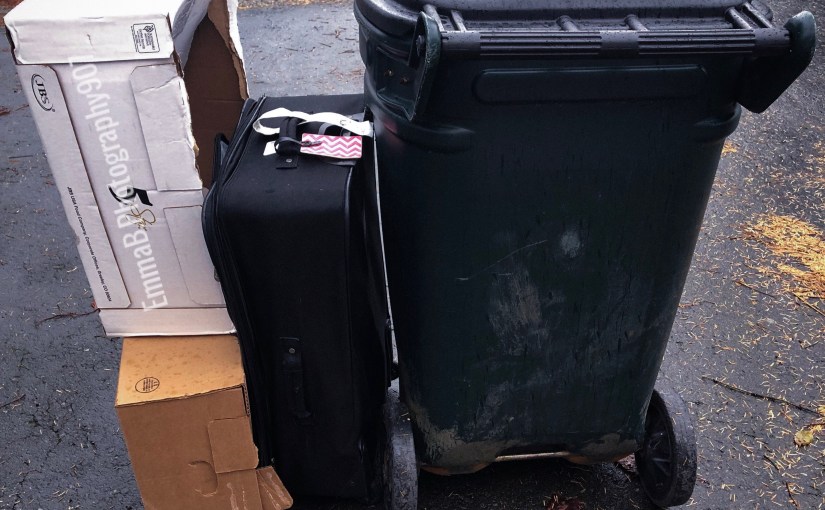
It’s been a thing we’ve seen time and again over the years with the kids who move into our home.  They know the routine.  They’re here. But who knows for how long?  It’s not a permanent move.  Just the next stop on the train.  Best to hang onto those boxes, old suitcases, broken laundry baskets, and garbage bags.  Just in case. Because when you’re in the foster system you never know how long you’re staying.  At some point the train pulls out again, and you’re off to the next station.

We’ve had kids arrive in our home with only the clothes they’re wearing. We’ve had them arrive in shoes that don’t match, and adult sized t-shirts hanging off of their small frames.  We’ve had a few of them come with their own chairs, dressers, and boxes and boxes of toys.  Most have come with all of their worldly possessions crammed into one or two beaten up old suitcases.  Or come through the front door, dragging all of their things in cardboard boxes and garbage bags.

This is my stuff.  Mine. It’s everything I have.  And it’s in garbage bags.  That alone speaks volumes to a kid about their own value.

Sometimes it takes them a few weeks even to unpack.  Best not to settle in.  Who knows how long they’ll be here?  We’ll start by showing them their room, and which dressers and bookshelves are theirs. We’ll follow up a few days later by reminding them and encouraging them to get their stuff unpacked.  And ultimately, after a couple weeks, sometimes we’ll tell them that it’s time to unpack now.  It’s time to settle in.

But what’s been interesting to us is how kids will hang onto those empty boxes. Those old battered suitcases.  The dirty, broken laundry baskets.  And even the garbage bags.  Even once things are unpacked there’s a hesitancy to let go of the empty containers.  Just in case.

For this newest kid it’s been a few weeks now.  He’s been unpacked since the first week.  He seems to be getting more comfortable.  He’s starting to lounge around in the living room when we’re all watching a movie, instead of hiding out secluded in his room.  He’s playing cards with the little kids around the dinner table in the evenings.  He’s snuggling in with the dogs while watching Mariners’ games with Geoff. He’s even starting to laugh.

So about those boxes.  Let’s go ahead and haul those out of here and get rid of them.  We know you’re on high alert.  We get that you’re hypervigilant.  Waiting to hear the train whistle that tells you it’s time to head out again.  On to the next station.  We understand that experience tells you to be ready to leave at a moment’s notice.  We get it.

And this morning when I told you to get rid of the boxes, saying it like it was no big deal, I knew it was a big deal.  I’m not really saying to go clean up your room.  What I’m really saying is, it’s okay to relax for a while.  Take a breath.  Start letting your guard down.  It’s time to settle in.

That’s Actually a Good Thing

Fear is a reaction to the unknown.  I’ve heard people argue that we can’t control fear. That it’s just a reaction.  But I’ve also heard people say that we choose whether or not we’re going to be afraid.  That’s it’s a conscious choice.  I’ve heard that fear whispers in the dark.  That it makes us see and hear things differently from how they really exist. And that fear lies.

I had pneumonia a year or so ago.  For two weeks I stayed home and sat at the kitchen table every day working on jigsaw puzzles.  That I never felt bored during those two weeks is pretty telling.  Normally sitting and doing only one thing all day long would be torturous for me.  But during those weeks just getting dressed and slowly making my way downstairs to the kitchen to make a cup of coffee wore me out.  I’d sit in a chair for a little while, sipping my coffee and getting my strength back up, before standing again to pick out a puzzle and carry it over to the kitchen table to begin my day’s activity.

After a round of antibiotics and two weeks of “resting” I still wasn’t feeling okay. My primary care provider wanted a chest x-ray.

The x-ray technician explained that they were going to take a look at the pictures before deciding if they needed to take any more.   I said okay, and waited in the x-ray room.  I wasn’t particularly nervous or afraid; mostly I was just tired.   But when I turned around I saw the two technicians pointing at something on my x-rays.   My glance fell to the x-rays, and immediately I could see that something was wrong. One of my lungs was light in the x-ray and appeared normal.  But nearly half of the other lung was opaque.  Whatever was in my lung was consuming a significant part of it.

I turned back around quickly, and my heart started to race.  The technician came back in the room and said they thought they had enough and that I’d be hearing from my medical provider.

Geoff picked me up, and I told him that I had seen the x-rays and they didn’t look good.  I told him that “half of one of my lungs is black” on the x-ray.  And that I was scared.

He tried to reassured me.   But his words didn’t comfort much.  I had seen the x-ray.  He hadn’t.  I knew he’d be worried too if he’d seen it.  I’d never seen anything like that before, and I knew it wasn’t normal.

My appointment with my medical provider wasn’t until 4:00 in the afternoon. And as the day progressed my fears took the shape of “something serious.”  I’d never been a smoker, or a miner.  I’d never particularly been around dangerously contaminated air.  But I had been having some breathing problems the last few years.  I had developed asthma.  And now this pneumonia that wouldn’t seem to clear up.  In my mind, with each progressing hour of the day my fears took on the shape of lung cancer, or lung disease brought on by exposure to something I hadn’t realized I was being exposed to.

By the time I went for my appointment I had already cried to Geoff about how scared I was.  So scared that I was almost physically sick.  I knew it wasn’t good.  I still had kids to raise, certainly I would do my best to fight whatever this was.  But sitting in the waiting room, feeling too exhausted to even walk back to the exam room, I tried to steady myself, tried to get ready for the fight.  Even though the thought of it, the fear of it, was overwhelming to me.

My provider was as calm as always.  She greeted me with a smile and asked how I was feeling.  I gave a non-committal answer, bracing myself for what I knew she had to tell me.

She said, “Well, I think we should try another round of antibiotics.”

Why wasn’t she saying anything about the dark mass filling my lung?

She examined me.  But still didn’t say anything about what was going on with my one lung.

I finally admitted to her that I’d seen the x-rays.  And that I’d actually been kind of scared all day.  I told her that I’d seen the big darkened area on my one lung. And that I knew that it wasn’t normal.

She put the x-ray up on the window asked me to show her what I was referencing.  With a slightly trembling hand I pointed to the darkened area on the x-ray.

“That,” I said, pointing to the part of my lung which was opaque.

She smiled.

“Okay, so that’s your heart,” she said.   “And that’s actually a good thing.”

I was stunned.

No cancer?  No tumors or growths?  No black lung disease?

I suggested that as a counselor maybe I shouldn’t be trying to read x-rays. She laughed.  And I think I could actually hear the air beginning to hiss out of the fear balloon that had been inflating around me all day.

Geoff and I chuckled about it in the car on the way home.  He pointed out that I had revealed to our medical provider what a dork I really am.   I started another round of antibiotics that evening.  And worked on jigsaw puzzles every day for another week.  The pneumonia did clear up.  And it has become just another story that I have told numerous times since,  in treatment groups and in meetings.

It was a day that I chose to drag myself through hell.  Or, that I let myself be dragged through hell.  For no purpose.  Over nothing. I gave in to fear and let it take hold of me and shake me around all day long like a puppy with a chew toy.  The fear took on a life of its own and changed my thoughts and my emotions.  In fact, within just a few hours of having me in its teeth, the fear had me re-writing my whole future.  Not only had I wasted that day.  I had handed over the remainder of my life to fear.  I had completely given up the controls.

I didn’t have cancer.  Or black lung disease.  I didn’t have an unknown mass, or a tumor.  I didn’t have anything more serious than some residual pneumonia which just needed a little more rest, and another round of antibiotics.  I had a heart, for Pete’s sake.  And “that’s actually a good thing.”

A Grateful Nation

            In and of itself, my dad’s death was hardly remarkable.  And yet it was breathtaking.  It was the everyday sunset.  A lifetime’s expectation.

            Dad was 80 when he died. An old man.  He’d been one of the lucky ones of his generation.  One of the ones who’d lived to old age.

            At 18 he’d enlisted with the Marines.  His older brother was already fighting in North Africa.  His older sister was in Europe with the WACs.  Two weeks before Dad was to leave, his father was killed in a highway accident.  Dad spent those next two weeks hunting, trying to fill the freezer as much as possible for his mother who was now alone to raise five younger children.

            Two weeks after his dad’s death, he headed off to basic training in Honolulu, and then shipped out to battles in the South Pacific.  During the course of the next three years Dad participated in five assault landings.  He was a radioman.  Always in the first wave of Marines hitting the beaches.  Guadalcanal.  Guam.  The Marianas Islands.  The Marshall Islands.  Okinawa.

            He returned a battle-weary 21-year-old man.  He went to college.  Then to seminary.  He married Mom.  Had Jim and Deb.  Was ordained as a Lutheran pastor.  Then had Jude and me.  He preached. Wrote books.  Spoke to groups.  Taught.  Led. Counseled.  Ministered.

            All four of us kids went with Mom to the funeral home that day.  There were decisions to be made.  Too many decisions.  Did we want a burial, or cremation?  Was there to be a viewing?  Open, or private just for family?  What kind of bulletins?  What kinds of flowers for the service?  Did we want this?  What about that?

            We knew Dad wasn’t there anymore.  And he wouldn’t have cared at all about his funeral arrangements.  We tried to go with what was most comforting to Mom. She, too, knew that Dad wouldn’t have cared one way or the other.

            Then the topic of his military service came up.  The funeral director informed us that the Marines would be present at the funeral if we wanted them.  She would call and notify them of the time and location of the service.

            I have quite a few memories of Dad’s funeral.  But the one that always bids the tears to come is the memory of the Marines.   The single bugler in the back of the church playing Taps while the others, in dress uniform, begin the folding ceremony up front. Then, holding the perfectly triangular flag, one marine approaches Mom.  With crisp precision he drops to one knee and presents her with the flag.

            “On behalf of a grateful nation,” he says, looking in her eyes.

            He said more.  But I didn’t hear it.  I stopped hearing after those first six words.  On behalf of a grateful nation.

            How many young boys, and old men, have been buried to those words? How many women, young and old, have been buried to them?  Those words are an acknowledgement.  The testament of recognition, and of loss.  It’s the realization of  loss which brings the tears whenever I think of it.

            A grateful nation. Which has been defended by, and protected with, the lives of thousands of young boys like my dad.  A grateful nation.  Which has been loved at tremendous personal risk and loss.  A grateful nation.  For which many of those lucky enough to survive, have fought nightmares and battle scars even into their 80’s and 90’s.

            To those boys, and those girls.  Those who serve.  Our nation is, and will be forever, indebted.  We will forever remember.  And we will be grateful.  To every single one of them.  Forever.

Fireweed

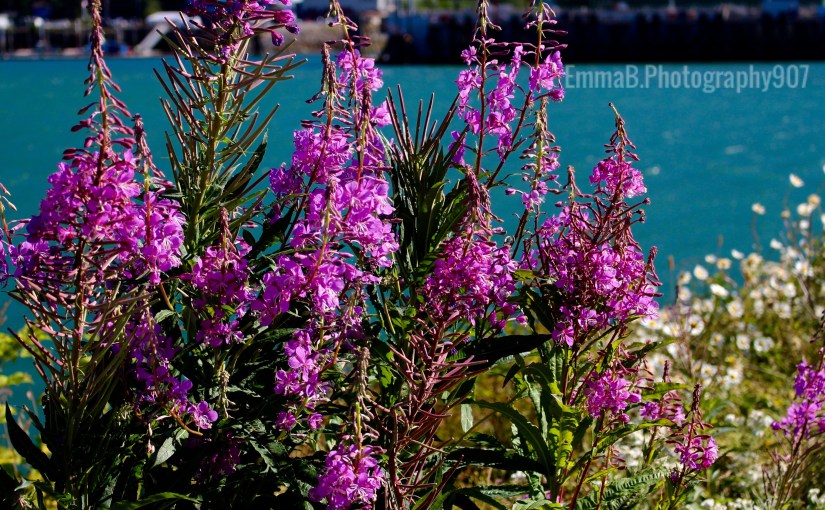
Fireweed is a well-known, and frequently photographed, plant in our area.  And it’s one of my favorites.

In late spring the fireweed stalks start shooting up.  By mid-June, they’re as tall or taller than me.   The top 12 to 18 inches are covered with buds which will bloom from the bottom up.  By August, the top few buds on the stalk are blooming, and we know fall storms are just around the corner.

Fireweed is lovely, adding a bright pinkish purple to an otherwise predominantly green and blue landscape.  It grows everywhere around here.  Filling meadows with a sea of pinkish purple, lining nearly ever path and roadway.

Fireweed is a pioneer plant.  So named because after a fire it is one of the first plants to return.  It reclaims and begins the rebuilding process following disaster. Bringing reassurance that life will return.  Even after total death and destruction.

A couple of our kids and I drove past a fatal car accident on the highway the other night.  We were on our annual drive south through British Columbia on our way down to visit family in the Lower 48 for vacation.  As we wound our way around a bend in the road we came upon flares and flaggers.  Noting only where I was being directed to steer the car, I wasn’t the first to see the wreckage.

“Oh my gosh, Mom!  Is that a car upside down?” asked our worried, 17-year-old daughter, Anna.

I glanced over to the side, still following the flagger’s directions with a nod. There, in the other lane, the lane I should have been driving in, was a vehicle upside down and sheared so that the roof of the car was actually level with the hood.

“Oh my gosh,” I whispered, and then quickly directed the little kids in back to close their eyes “really tight.”

There was a blue tarp covering part of the car.  The other car, not nearly as devastatingly smashed, though still totaled, was jack-knifed in the road with the entire front end of it wiped away.

In a moment, we were through the carnage and on our way again.  Except for a part of us. The part which remained back there at that accident site.

“Mom, somebody had to have died in that car,” Anna said quietly, trying not to draw the interest of the younger kids in back.

I could hear the sadness in her voice, and I agreed.  I said that with the way the car had been crushed down I didn’t see how anyone could have survived that.

A few miles later she broke the silence again.  “I wonder what happened.  Do you think somebody was drunk?”

I said that it could have been.  Or it could have been that a driver was driving too fast, or maybe adjusting the stereo or turning to talk to someone else in the car, momentarily distracted.

She nodded, still looking stricken.

The next two hours, as we finished the drive to our hotel for the night, we didn’t talk about much other than our thoughts regarding the accident we had seen. My heart was heavy with the obvious tragedy.  Wondering about family and loved ones whose day-to-day lives had just been horribly altered.  I thought about what it would be like to be going about your regular routine only to have it disrupted by news of a terrible accident somewhere out on a highway. Your family, whom you thought were returning home, are gone.

I thought about the devastation.  Wondering if the people in the car were parents, whose children were now orphaned.  Or if the people in the car were adult or teenage children, whose parents were now alone. I thought about the destruction that can happen in the blink of an eye.  Just around a bend in the highway.

The next morning, we drove through an area of forest fire.  As we drove through the worst of the smoke, I got to thinking about regeneration.  And pioneer plants.  The hardy species which first take hold after devastation and encourage other less-hardy species to return, as well.  I wondered how it must look to see those first bright green stalks of fireweed shooting up, and then blooming, in an otherwise blackened landscape of charred, dead trunks, and ash.  Those purple blossoms, bursting forth in all their promise, as reassurance that life will return.  Even after devastation.

And I wonder what will serve as fireweed for the family and loved ones of those whose lives ended the other day just around that bend in the highway. Their lives now devastated.  Destroyed by loss.

But there will be fireweed moments.  Little shoots of life, seeming almost insignificant.  But not insignificant at all.  Which will emerge from the ashes and death.  A chance remembrance that brings a smile.  A moment’s laughter mingled with tears.  A second’s lightheartedness from the heavy burden of grief.  At first, these fireweed moments will go unnoticed.  But they’ll continue to grow, and will blossom.   Bursting forth in all their promise.   Reassurance that life will return.

The fireweed haven’t yet started to bloom this year.  But the stalks are growing.  Pretty soon the buds will begin popping out.  And they’ll bloom again.  And again. And again.