Keeping Someone Warm

“These are the only clothes I’ve got,” she said, gesturing toward her pants and top.  “When I’m drinkin’ I mess myself.  So then when I sober up I have to throw out whatever I was wearin’.”

I nodded, encouraging her to continue.  I asked where she was living right now.  If she had a place.

“Under stairways mostly,” she answered, looking me in the eye.  “I don’t sleep too good.  Never have.  I don’t like to be closed in.”

I asked if she was bothered by nightmares and she nodded, still looking directly at me.  

“Yeah,” she said, after a second or two.  “There’s a lot to that.”

I said that I think there’s always a lot to it when someone has frequent nightmares.

She agreed.  

We talked briefly about post-traumatic stress disorder.  I explained how when scary things happen to us those images get stored in a part of the brain where they’re easily accessible, instead of being filed away with all of our other memories.  So the brain continues to let us know that it’s got something misfiled by giving us flashbacks and nightmares.  

She was still looking directly at me.  I said that a lot of times those PTSD symptoms go back to scary things that happened to us when we were children.  Then I waited.

“Yeah,” she said, still looking at me.  “I got molested most of my childhood, and then raped as a teenager. I don’t even know how many times I’ve been raped as an adult.”  She was quiet for a second.  “It’s all still right here,” she said, putting her hand on her chest.

She’d just gotten out of the hospital.  Intensive care.  She’d been there for several days, having woken up one morning feeling “not right.” A friend had helped her walk 3 miles to get to the hospital where they discovered that she had an upper GI bleed.

“I think it almost killed me,” she said.  “I went through the whole thing in the hospital.  The DTs, hallucinations, feeling cold, then hot, shakin’, feeling things crawlin’ on me, vomiting blood.”  

I asked how long she’d been out of the hospital and she said this was her third day.  And so far she’d been able to “stay away from the bottle.”  But, “I want it.  I want it real bad.  All the time. I walk by the liquor stores and the bars.  And if I had any money at all, or found anybody to give me some money, I’d have a bottle.  And then I’d go lookin’ for another bottle.”  

She was just a few months older than me.  But she looked quite a bit older, except when she smiled.  She said she’d been homeless for “a while now,” saying again that usually she finds a safe place to stash her things in bushes and that there were a few different stairways around town which she would sleep under.

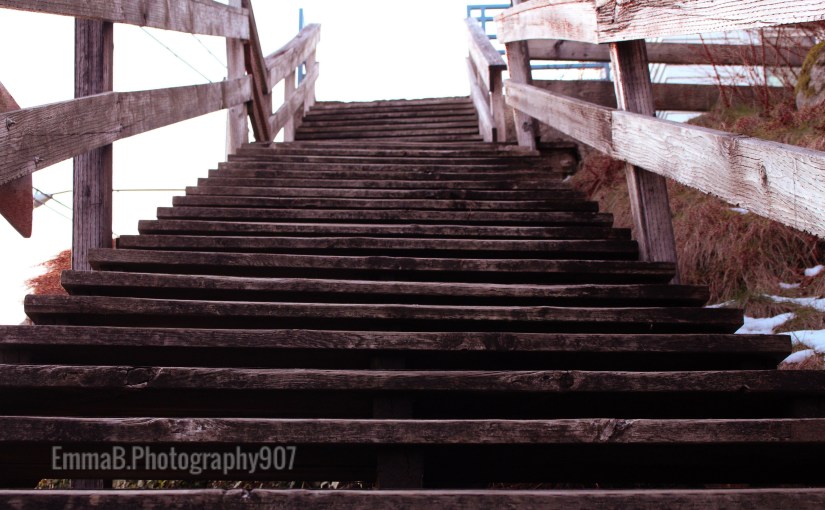
Our town exists between the ocean and the mountains.  It’s several miles long and only a few blocks wide.  The stairways she sleeps under are outside wooden stairs.  Shortcuts up the sides of hills.

Winter is around the corner, and as she talked I was thinking about how cold the last few mornings have been.  I asked if she had enough things to keep herself warm. A coat, or sleeping bag.

She smiled and reached down into her backpack to pull out a big black sweatshirt. It had a picture of a fishing boat on the front, and the name of a company.  

“I picked this up.  It’s big on me,” she said, pulling it on over her head and wrapping her arms around herself.  “But it’s been nice and warm on these nights.”

I knew that sweatshirt.  I’ve washed it dozens and dozens of times.  The tear on the side of the front pouch guaranteed to me that it was the same one.  

It had belonged to one of our sons.  Given to him on his 16thbirthday by one of his older sisters.  It had been worn frequently for a couple of years, and was one of the things that was given away in a bag of clothes when he left for college.  

I didn’t say anything about recognizing the sweatshirt, or that I was glad it was being used.  We continued visiting.  We talked about the disease of alcoholism and how it is non-discriminatory.  She said that she knows a lot of people who don’t believe that alcoholism is a disease and I laughed, telling her how much I love educating those people.  

She smiled at that.  Then she looked away for a second or two.  And I sat quietly, watching her.  

“I gotta get to treatment somewhere,” she said.  “I’ve been before a couple of times.  But I need to go again, and I need to stay sober this time. Or I’m gonna die.  These last few days I think I was pretty close.  And I’m too young to die from the bottle.”

We made a plan to help get her into a treatment facility, and I asked if she would be safe for the next week or so until we could get her somewhere.  The need for treatment beds is exponentially greater than the number of actual beds available.  Sometimes it gets tricky.  And sometimes it’s  a slow process.  She nodded as I explained all of this and when I encouraged her to work with us so we could get this done.  Then she told me what her plan would be to stay safe while we did the leg work to get her a treatment bed.  

When we parted I told her how much I had enjoyed meeting her.  She still had the huge, black sweatshirt hanging off of her thin frame, and had to shove the sleeve midway up her arm to shake my hand. We both chuckled.

“My big, warm, jacket,” she said.

When I got back to my office I texted my son at college to let him know I’d just seen his sweatshirt.  And how it was being used.  To keep someone warm at nights while she’s sleeping outside under stairways because too many bad things happened to her when she was young and she can’t stand to be closed in, and can’t sleep because of nightmares.  He texted back that he was glad to hear that his sweatshirt was being used.              And this evening I’m sorting through my clothes again.  I’ve got more things than I need.  Things I don’t even wear.  Things that could be keeping someone else warm tonight. 

All About The Timing

We were in church that Sunday morning.  One of our teenage daughters was in an ugly mood. I don’t think we had any idea what had caused her mood, nor did I particularly care.  We’d had a hectic morning getting everyone up and ready for church.  Shortly after we sat down in church I could see that she was upset about something.  But by then I was worn out enough that I probably just rolled my eyes about it.  

With eight teenagers in the house, getting everyone up and ready, and explaining that yes, we really were going to church today, was becoming more of a struggle than it often feels like it’s worth.  I was irritated by this.  We have always gone to church.  But lately, all of a sudden, it has become a major discussion every Sunday morning.  A test of wills.  Are we really going?  Yes, we’re really going.  Just like we’ve gone your entire life.

Our daughter who was in the mood was on my left.  Our 15-year-old son Ben was sitting to my right.  The service was just beginning when he leaned forward to look past me at his sister.  Then he whispered to me, a little too loudly, “What’s wrong with her?”

Annoyed, I whispered back, “Who cares?”

He looked again at his sister, then back at me, and sat back in his seat.  Satisfied that yes, she really was in a bad mood, and no, he wasn’t going to find out any details about it until later.

At that point, 16-year-old Anna, who was sitting directly in front of me, turned around and whispered sarcastically, “Nice one, Mom.  That was way too loud.”

As is often the case, I wasn’t particularly interested in any feedback at that moment.  She turned back around in her seat, and it wasn’t until after the service that I found out the rest of the story, when with eyes rolling, and dripping sarcasm, she mimicked my earlier comment to Ben.  

“So then Mom says, ‘Who cares?’” she said loudly, bobbing her head from side to side, arms lifted in a dramatic shrug.

So it turned out that while our family was still in the throes of just trying to get everybody to church that morning, the rest of the congregation had been at the beginning of the liturgy in that moment.  They were at the part where the pastor says, “…God sent His most high Son, Jesus, to die for us…”  That was the moment.  That was what was happening around me, in the service.  That was what I should have been focused on, instead of focusing on my teenager’s ugly mood.  That was the exact second in time when I responded dismissively to Ben’s question of concern over his sister who was in a foul mood.

In music they call it a mashup.  When you take two separate pieces of music and play them together, overlapping them. Sometimes the result is really pretty cool.  

My experience in church was not so cool.  My mashup was a little more, well, unfortunate.  My Sunday morning mashup went something like this:    

Pastor:  “…God sent His most high Son, Jesus, to die for us…”

Ruth:  “Who cares?”

No one in the congregation asked me about it after church.  No one expressed concern over how I was doing.  Or even just shook my hand and held on for a second longer than normal.  Our family, all 12 of us who were there that morning, got a good laugh out of it later when Anna regaled us over and over again with the full story of how things went down.  How my timing, my mashup, was really just unfortunate. 

But then I guess I deserved that.  For not paying attention to what was actually important.  For being more focused on my teenaged daughter’s foul mood, and how annoying I found it, than on the reason why I was there in the first place.  For getting distracted, and not watching my timing.  Because it really is all about the timing.

Making a Difference

Geoff and I have tried to make it a practice over the years to periodically, intentionally, reflect on our lives.  We reassess where our time and energies are going, we talk about what has the highest return on our time and energy investments, and we re-prioritize if necessary.  Not infrequently, we find ourselves wondering if anything we are doing is making a difference in any way, in any life, in the world around us.  And most of the time we come back to the same conclusion that we just really don’t know.

I was in session with a client whom I care about a great deal.  She had been struggling to survive a severe bipolar disorder for a couple of years.  We were in the month of March, and the manic part of her bipolar disorder was awakening from the hibernation of depression she had existed in during the dark winter months. 

She was recounting for me a particularly difficult weekend.  An alarmingly difficult weekend.  Painstakingly identifying how deteriorated things had become.

“I haven’t been sleeping.  I’ve been up since three o’clock this morning.  I’m cycling rapidly from feeling really up and having lots of energy, to feeling up but having no energy, to experiencing these rages that come suddenly and make me want to tear out all my hair.”

I nodded, listening and feeling increasingly alarmed.

“On Sunday I couldn’t make my brain slow down.  And I couldn’t get my body to move nearly as fast as my brain.  So I decided to go for a drive.”   She shrugged.  ”I know, probably not my best decision.  Anyway, I drove the back route to the mountain, figuring I was going to climb that mountain.  Today. And if I disappeared, that was okay.”

I was familiar with that mountain.  That particular trail climbs 4000 feet in elevation.  

“The whole parking lot was full.  I don’t know what all those people were doing there.  Heck, it wasn’t even nice weather.  I figured maybe it was a church picnic or something.  Anyway, I flew out of there in a rage.”

I nodded.  Grateful to God that enough people just happened to fill up the mountain parking lot that afternoon so there was no place to park.

“Then I decided to go out to the glacier.  38 degrees.  I knew there’d still be ice.  And if I accidently fell through it on my way to the face of the glacier, so be it.  No one would have to know it was intentional.” She stopped for a second, picking an invisible piece of lint from her lap.   “But I get there, and heck, there’s not even a place to park.  Not a single spot.  Both lots at the glacier are full.  There’s people everywhere!  Stupid people.”

I smiled.  Silently thanking God for saving His kids.  Time and time again.

“So I drove over to another lake.  I’m thinking, ‘I’m gonna gun it, and drive off the edge of the road out into the lake.  I’ll drown, trapped in a submerged car, under the ice.’  But as I get to where I’m gonna start gunning it I see two people out walking on the bike path by the lake.  Right where I was  going to go in.  And, I mean, I wanted to end this.  But I didn’t want to take anybody else out with me.”

She stopped for a second, collecting her thoughts.  

“I’m speeding away from the lake.  At this point I didn’t even know where I was going next.  I was in a rage.  Frantic. And there’s this red truck. Bright red truck.  Right on my tail.  I don’t know what that guy was doing.  But he kept following me.  So, I just kept driving.”

The story went on, describing one or two more suicide plans all within a period of a couple hours.  And each time, through a series of events, by coincidence, each plan failed.  Until, at last, the tidal wave of rage subsided and she wound her way back home defeated.  

She was in trouble.  We talked about developing a new safety plan, one which might include hospitalization. We identified who all needed to be notified of how serious things had become for her.  Then we took steps to activate her new safety plan.  

And on my way home later I got to thinking about making a difference. About how often we go through life wondering if we’re doing anything that makes a difference in any way, in any life.  And my thoughts focused on the two people walking around the lake that Sunday.  And the guy driving around in the bright red truck. The people who drove out to the mountain that day probably for some kind of group get together.  And all those who filled every single spot in the parking lots at the glacier.  

There is a remarkable woman who is alive today because of you.  Because for some reason that Sunday afternoon you decided to go for a walk, or out for a drive, to the mountain, or the glacier.  And although you have no idea how important that decision was, thank you.  That Sunday you saved a life.  That Sunday you made the difference.

Just Clutter

One of the most frequent issues that comes up when I’m doing family counseling will have to do with the house being messy.  In fact, messiness and cleaning chores almost always arise as an issue in family counseling.  I hear from families that they have too much stuff, that they can’t keep their house clean because of it, and that it increases their stress.

“We never have anybody over anymore because our house is such a mess.”

“We have way too much stuff.  It’s taking over our house.”

“I think we’ve spoiled the kids by giving them too many things.”

“You can’t even sit down in our living room because there’s stuff everywhere.”

“The kids’ rooms are a mess, but then so is our room.”  

“I don’t even know where to begin anymore.  It seems like our house is beyond anything I know how to organize.”

We’ll start to focus on the topic of clutter.  Things. Stuff.

We as a culture have more things than ever before.  We’re spoiled.  And we’re spoiling our children.  As much as any parent will say that their children have way more things than they had growing up, what they don’t say is that they as children had way more than their parents had growing up.  It’s a multi-generational trend.  And it’s out of control.

I had a parent tell me in session the other day that he can’t get through his daughter’s room to repair something that needs repair.  “She has so much stuff on the floor, I don’t know where to step.  And then she’ll say she doesn’t have any clothes, and I think it’s because there are so many clothes on the floor, she doesn’t know what’s clean and what’s dirty.”

Stuff. Too much stuff. Which is gluttonous.  And ends up robbing us of our peace.

We’ve been in the process of trying to control some of the clutter at our house lately, too. We’ve taken on a room at a time, working to get rid of stuff.  Giving away what could be used by others whether it’s the used book store, the homeless shelter, the second-hand store, the food bank. Recycling whatever could be recycled.  And throwing away things that are beyond usefulness.  As each room is completed there’s a peacefulness to it which wasn’t there before our efforts.  The progress is slow-going.  But it is progress.  Room by room our house is becoming more peaceful.  Just by getting rid of the clutter.

I heard someone define clutter recently, and it’s gotten me thinking.  Clutter, the person said, is anything we choose to hang onto which doesn’t enrich our lives.  

Simple definition. One which covers a whole lot of things, actually.  Clutter doesn’t mean junk.  Clutter can mean just about anything, as long as it’s no longer useful or helpful.  And no longer enriches my life.

The books we’ve read, and will probably never re-read.  Why are we just collecting them when someone else could be reading them? Clothes the kids have outgrown, or ones we no longer wear.  Someone else could wear them.  Why are they still in the closets and dressers?  The food on the shelves which we don’t need, and won’t use.  Things which are broken but we’ve hated to get rid of for some reason.  Though the reason doesn’t really jump out at me.  Scraps of paper with phone numbers written on them.  Old toys no longer played with.  Pens which no longer write.  Kitchen containers without lids and lids without containers.  Other things whose usefulness has long since ended. If they’re no longer useful, they’ve become clutter.  All clutter.

None of these things have enriched my life.  The shelves of read books, the pantry full of food we won’t use, the clothes I no longer wear, the remote control to a television we no longer have, the broken cell phones, the kitchen gadgets I’ve never used and don’t know how to use.  None of these enrich my life.  The accumulated effect of all of them, though, weighs me down, robs me of peace in my home, and makes our home feel cluttered.

There are other sources of clutter too.  Hurts, fears, frustrations, irritations, stress, anxiety, weariness, pride, anger, resentments, bitterness.  Things we often choose to hang onto, sometimes for an entire lifetime.  But none of which enrich our lives.  

We’re going through the rooms of our house right now, one room at a time, sorting and organizing, figuring out where things came from, and whether they’re still useful or not. And if not, working at getting rid of them.  De-cluttering our house.  Giving away that which can be useful to someone else, and throwing away that which has outlasted its usefulness to anyone.  Room by room we’re making headway.  Creating order out of chaos.  Once again working to make our house more peaceful.  And when we’re done with all the rooms of our house it will probably be time to start the process over again.  Room by room, de-cluttering the house, again.  

As for that other stuff, the emotional stuff, there’s clutter we need to get rid of there, too. Sorting and organizing,  figuring out where things even came from.  And if they’re not useful, working on getting rid of them.  Getting rid of the stress, the fears, the frustrations, the irritations, the old hurts, the anxiety, the weariness, the anger, the resentments, the bitterness. All of it.  It’s just clutter.  Things we’ve chosen to hang onto, which haven’t enriched our lives.  

Under Seige

Our house had been invaded.   We were under siege.  We had no choice other than to engage in battle, night after night, fighting to retake our home.  For the first time in my life we were living in an enemy-occupied territory, and it was exhausting.

Naively, when we noticed the first chew marks, after we had convinced ourselves that these truly might be the work of rodents, we thought in singular terms.  Mouse.  Rat.  We might have a rat.  Probably just a mouse.  Looks like something chewed into this bag of raisin bran.  Do you think we might actually have a rat in the house?

 It wasn’t until after we’d found a dead rat in a trap, and still laid sleepless at night listening to gnawing inside our walls, that we began to think plural. Rats.  We knew we’d been invaded.  And that these were not cute little mice.

That’s when our lives changed.  We began new morning routines of surveying the downstairs.  Checking traps.  Looking for rat droppings.  Signs. Indicators that they were still running unchecked through the downstairs at night.  Under the floors.  In the walls. They had the run of everything.  

Each morning we’d bleach and disinfect.  Every counter.  Every surface.  Anything left out during the night.  

Each evening before we headed upstairs to bed we set traps.  Trying to outsmart the rats.  Trying out different types of traps.  Different types of bait.

We were hearing them.  We were seeing signs.  Signs of their occupation.  A ripped up towel in a kitchen drawer.  Droppings. A gnawed banana on the counter.  A cereal box with a hole in it.  A shredded sheet in the linen closet.  The pest control guy had said to cut off their food supply.  We’d done that.  But still they persisted.     

As we sat puzzling about this one morning over a cup of tea we decided to search the house one more time to make sure there wasn’t another food source somewhere that we didn’t know about.  

That afternoon we were looking through the bathroom closet which extends back about eight feet under the stairs.  We store sleeping bags, backpacks, winter coats and snowsuits in there.  As we started digging though everything we noticed some stray pieces of dog food, and rat droppings.  

And then we saw it,  in the very back of the closet, a 50 pound bag of dog food with a hole about the size of my fist in the top of it.  We had forgotten that months earlier there’d been a good price on dog food so we’d gotten an extra bag and stored it in the back of that closet.    As we surveyed the pieces of dog food scattered all over the closet we knew we’d found the food source.  

We began hauling out all the contents of that closet and throwing it all in a heap in the middle of the bathroom.  We stopped when there was just one sleeping bag left in the back of the closet, and it was bulging with bits of dog food.  

 “Oh gross,” I muttered, as we pulled out that last sleeping bag.    

Geoff carried it outside to the garbage can while I swept out the closet.  I had just sat down on the lid of the toilet to finish sweeping.  I moved the bathroom scale from against the wall to sweep out behind it and out charged a huge rat.  Straight at my feet.   I was wearing only socks, though why I hadn’t put on my combat boots I don’t know. The rat ran over my toes, and darted into the safety of the pile of winter coats, snowsuits, and sleeping bags still in the middle of the bathroom.

I recall calmly calling out to Geoff,  “Honey, can you come here a minute, please?”

Though he and the kids still swear that I screamed.  

A second later, 10-year-old Ben popped his head up through the hatch in the hallway, which was just outside the bathroom door.  

A year earlier we’d cut a hole in the floor of the hallway closet and put in a hatch with a ladder that led down to the first floor of our house.   The hatch allowed the kids to come and go to a large playroom, without first having to go outside and through the garage.  

Hearing my calm request for Geoff had peaked Ben’s curiosity.  And he suddenly appeared, with his head poking up through the hatch.

“Get off the ladder!” I commanded wildly, envisioning in that moment that the rat would run at him and go down his shirt.  Ben, terrified as I was sure he would be, would fall off the ladder and get hurt.  On top of being traumatized.

“What’s going on?” Ben asked interestedly, ignoring my command.

In that second, the rat darted from under the pile of winter gear and sleeping bags, out the bathroom door, and straight for Ben’s head, which was right at floor level.

“Get off the ladder!” I commanded again.

Like a deer in the headlights, Ben’s stared wide-eyed as the rat ran directly at him.  It charged to the edge of the hatch, hesitated just a second, and then dropped straight down to the playroom below.

I shuddered.  Poor Ben. It hadn’t actually jumped onto his head and run down his back to make its escape.  But surely it had to have been terrifying to have a huge rat charging right at his head.

I was nauseous, and outraged.

“Oh wow!  Did you see that?” Ben exclaimed, clearly thrilled at what he had just experienced. “It ran right at me!  And jumped!  Like no big deal!  That was way cool!”

I was again sitting on the lid to the toilet.  Jittery. Exhausted.  Trying not to cry.  As I contemplated a hotel room for the night, and hiring the pest control guy to come spread toxins throughout our house, Ben could not stop talking with growing enthusiasm.

“That was so cool,” he laughed loudly.  “Wow!  I mean, I heard Mom scream.  So I came up the ladder to see what was goin’ on.  And this thing…this rat…came right at my head!  I was like, ‘Whoa, Buddy.  Slow down or somethin’.’” 

Quickly, his recounting of the event started to grate on me.  I closed the bathroom closet.  Turned off the lights.  And shut the door.  I told Ben to come upstairs now.  And to shut and lock the hatch.  Geoff got out the peanut butter and began preparing two more traps.  These, for the playroom.

As evening approached I bleached the counters, again, before preparing dinner. My normal interactions with Geoff and the kids were done for the day.  I was void of emotion and affect.  Shell-shocked. Traumatized by the experiences of the afternoon.  I thought about just selling the house.  Or torching it.

Ben, on the other hand, could not stop talking.  Excitedly.  Enthusiastically.  Recounting, again and again, with nauseating details of how thrilling his experience with the rat had been.  He finally paused for a second, a sudden and welcomed break in his endless monologue. 

“Hey, Dad.  You don’t suppose if you and me go down and just catch it–like get the nets for the fish tank and net him–that we could keep him, do you?”

Yeah, right! I spit out the words in my mind.

“No, Ben.  We’re not going to keep the rat and try to turn it into a pet,” Geoff answered, eyeing me. Realizing, I’m sure, that his marriage hung on that answer.

I went back mindlessly to my dinner preparations.  And Ben went back mindlessly to more incessant talk about the rat.

“Hey Dad, do ya think we could bait my casting pole?  Then I could just sit in the hallway and put my line down the hatch and jig for it.  Just to see if we get somethin’!” 

I rolled my eyes.  

“We’ll see, Ben,” Geoff answered.  And I scoffed.

I went to bed that night listening for more scratching and chewing in the walls. Nothing.  I still felt shaken, and emotionally drained.  I puzzled for a while over how something which had so traumatized me could have been so delightful for my son.  And I hoped that today’s events hadn’t permanently damaged my relationship with him.

Realistically, I knew we’d get that rat.   And his wife, his mother and father, siblings, children, grandchildren, extended family, and family friends.  We already had a plan to step up our own counterattack.  And I was fairly confident that by the time this war was over we would be the victors.  And our house would once again be ours.

But for now, we had no choice other than to engage in battle.  On every front.  We were, after all, under siege.

One More Thing to Say

There are some life lessons which I seem to learn over and over and over again.  Or maybe it’s that I haven’t really learned them yet so the opportunity is presented over and over again.  Regardless, one of those frequently repeated lessons, which I may not have really grasped yet, is that I don’t know as much as I like to think I know.  

My mom had been living in an assisted living facility just a few blocks from our house.  She’d been diagnosed with Alzheimer’s-type dementia some years previously, and we had only recently made the move from having her live in our home to living in an assisted living facility.  

My dad had died nine years earlier, and in those nine years Mom had told us repeatedly that she was “ready to go” and in fact she wanted to “go.”  

I had been complaining to God for some time about my mom’s situation. Watching her deteriorate, and frequently being on the receiving end of her fearful and frantic outbursts because she didn’t remember where she was and nothing was familiar to her anymore, was taking its toll on me.  I knew her heart’s desire was to go Home, to be in Heaven with my dad.  She had told us this enough times.  She had been a faithful child of God her whole life.  I didn’t understand why God was leaving her here to suffer.  

The more I complained to God about it the angrier I got.  Or maybe the angrier I got the more I complained to God. After each heartbreaking experience with Mom I would retreat to scream at God.  In my hurt and anger I had actually gotten to the point of flippantly telling God that I thought I would do a better job at being God than God does. That I didn’t appreciate a God who didn’t seem to even notice that my mom was suffering and afraid.  That this reality of God was not the God I knew.

Actually, I guess the fact that I wasn’t immediately struck by lightning for my impertinence is probably itself a testament to the graciousness of God.  The gracious God I had always known.

One day when I had gone to visit my mom I was met at the door of the assisted living facility by a client of the agency where I work.  She was a young woman who had served several years in prison and had been mandated to substance abuse treatment at our agency.  She had only recently completed treatment, and couldn’t wait to excitedly tell me that she had just landed her first real job.  She was now working at the assisted living facility where my mom lived, and in fact would be taking care of my mom.  

The counselor code of ethics says that we will avoid dual relationships with clients. And here I was suddenly in an uncomfortable and unavoidable dual relationship.  My 85-year-old mother who was struggling to live her final years with dementia was now being cared for by a client.

Over the next weeks I did my best to avoid contact with the woman, whether at the assisted living facility where she was caring for my mom, or at the agency where she herself was continuing to receive counseling services.  I continued to visit Mom every other day.  And I continued on a regular basis complaining to God, asking what in the world God was doing keeping Mom here instead of letting her go Home.  Her quality of life had diminished significantly.  She felt she no longer had a purpose.  She looked forward to nothing.  She was confused and scared every day.  

I couldn’t fathom why God was leaving her here to suffer.  Why God seemingly wasn’t paying any attention to what was happening for her.  

One day I was notified that the woman had shown up at the agency without an appointment and was asking to speak with me.  I said okay and went out to the lobby to greet the woman and usher her back to my office.  

I didn’t know her whole story.  I knew she’d been an addict since her teenage years.  I knew that she had a handful of children, none of whom she was raising. I knew she’d done jail time, and that she had recently completed residential treatment.  And that these last few months had been her only real experience with being clean and sober.  I knew she was tough.  And I liked her.

 When we sat down in my office I asked her what was going on.  She took a second to gather her thoughts.  It was obvious that she was struggling with something.  

“So last night,” she began, staring straight ahead at nothing, “I was helping your mom get ready for bed.”

My discomfort increased at that.  If this was a session to talk about her care of my mom it wasn’t appropriate to be doing it at the agency where she herself was a client.  I was trying to figure out how to derail this conversation when she continued.

“And when I finished helping her she smiled at me,” she stopped to take a deep breath.   “Then she takes hold of my face with both her hands,” and again she stopped for a second to breathe.  Her expression flat and her eyes focused on something beyond the wall of my office.  

I waited.

“And she says to me, ‘You are such…..a sweetie.’”  

The sob broke through on the word,  “sweetie.” She leaned forward in her chair, pressing her hands against her face.  And in a second or two the tears started to drip through her hands onto her shirt.  

 “No one,” the woman continued, working to get the words out through the sobs, “in my whole life,” and she sucked in another ragged breath, “has ever…. called me….’sweetie.’”

We sat there in silence for a while after that.   She didn’t need me to say anything.  She had just needed to tell me about her experience last evening.  I thanked her for coming in to tell me this and I said that it had meant a lot.  She nodded and collected herself.  

A few minutes later I apologized to God.  For my complaints.  For my flippancy, and my impertinence.  

And once again, I realized that I often don’t know as much as I like to think that I know.  Here I’d been so caught up knowing that Mom didn’t feel she had a purpose anymore, that I had started to believe it.  I’d started to believe that her life was over and that God had somehow just forgotten about her.  Leaving her here to languish.  For no reason.  

But I was wrong.  Again. There was a reason.  Mom still had a purpose.  One for which she was uniquely qualified.  Because there was just one more thing which needed to be said. 

Right Above the Sink

On our kitchen windowsill, right above the sink, is an empty, scratched up, little plastic liquor bottle.  The kind sold on airplanes.  I’m not sure where it came from.  But I do know how it got there.

I have been collecting old bottles and jars for some time now.  We have found them over the years on pieces of property we’ve owned, and on beaches.  We’ve dug them up, pulled them from under rocks, retrieved them from the water.  

As my collection has grown, and my children started to show an interest in helping me collect things, I have gotten pickier about what I’ll actually bring home.  My preference is for old cork-topped bottles. I like blue, pinkish, clear, and green glass. And very rarely do I hang onto something cracked or broken.  Only intact bottles or jars make it home.

One day, years ago, I noticed a little plastic bottle on our kitchen counter. It was dirty, and thankfully empty of whatever it had once held.  With a grimace, I picked it up with two fingers and put it in the kitchen wastebasket.

Later that day, I found the same little plastic bottle on the bathroom counter near the sink.  It had soap bubbles in it.  Obviously someone had been trying to clean it.  It was scratched up, and cracked.  Most of the label was torn off. I could see that it had been a little liquor bottle.  Again with two fingers, and probably a look of disgust, I picked it up and threw it in the bathroom wastebasket.

“Hey, where’d this filthy little liquor bottle come from?” I called throughout the house to no one in particular.

No answer.

“Hmm.  Well, it’s gross.  And I don’t want to find it anywhere again,” I finished hollering out.

Still no answer from anywhere in the house.

That evening after dinner I went upstairs to start getting kids into pajamas. There, in the upstairs hallway, was the little plastic bottle again.  I couldn’t believe it.  The bubbles from earlier were gone, the label was now completely removed, and it had been dried off.

“Okay, what’s the deal with this plastic liquor bottle?” I again hollered to anyone who could hear me.  “I don’t know who’s playing with this.  But don’t. It’s gross.  We don’t know where it came from or what kind of germs it has on it.  I don’t want this thing in the house anymore.”  And for the third time that day, I picked it up with two fingers and deposited it in a wastebasket.  This time in the upstairs bathroom.

A short while later, as I was hustling everyone to brush teeth and wash hands and faces, I found four-year-old Anna alone in her room, red-faced, with eyes full of tears.

I asked her what was wrong.

She sniffled.  And as so often happens when I show any concern during one of the kids’ crying episodes, she erupted in a new round of sobs.  I sat down on the bed and rubbed her back.  

I asked if she was okay.

She nodded, still crying.

“Okay.  So what’s wrong?” I asked again.

“I found you a bottle for your ‘lection,” she stammered through sobs. “I washed it up and made it pretty. And I keep findin’ it in the garbage. I found it in the kitchen garbage. I found it in the downstairs baffroom garbage.  And now,” a new round of heavy whimpers, “now, I just found it in the upstairs baffroom garbage.  I wanted it to be a present for you.”

“But Honey,” I started to say.  I was going to explain to her that I collect old glass bottles, preferably cork-topped, and that I really prefer blue, pinkish, clear, or green glass.  I was going to tell her that this was just a plastic liquor bottle.  The kind they sell on airplanes.  I was going to tell her that it was germy, that we don’t know where it came from. That it really was just garbage. But, just this once, I stopped.

She was looking up at me through the tears.  Waiting for me to say something.

“Well,” I began.  “I was the one who kept throwing it away because I didn’t know who it belonged to. And I thought it might be dirty. It’s a bottle, probably from an airplane.  Where did you find it?”

“I just found it,” she shrugged.  “But if it’s from a’ airplane, how did it get down here?”

I said that I didn’t know.  And that I guessed that was just part of what made it special.

“Yeah,” she said.  “Do you like it, Mom?”

I said that I liked it, and that I bet we could get it really clean if we put it through the dishwasher.  

She dragged an already damp sleeve across her face to mop up the rest of the tears, and smiled.  We hugged for a minute.  And that dirty little plastic liquor bottle, the kind sold on airplanes, found a place in my heart.

We put it through the dishwasher.  And it held up just fine.  From there it ended up on the windowsill.  Right above the kitchen sink.  With some of my other special things  

For me, it’s been a constant reminder.  Of what matters.  And what doesn’t.  And that I need to keep watchful.  Because sometimes what’s valuable might at first glance appear to be just garbage. And sometimes something as unassuming as a little plastic liquor bottle might turn out to be pretty special.  

I know.  I’ve got one of those.  On the kitchen windowsill.  Right above the sink.  

Mismatched Plaids

I’m not sure when it started, or how it started. But some time ago one of the boys in our family wore a plaid shirt to church one Sunday.  Just one time.  Apparently, one of that boy’s brothers took a look and decided that the plaid shirt looked good.  And the next week a couple of our boys wore plaid shirts to church.  

But it didn’t stop there.  The idea spread down the pew.  Pretty soon all of our boys, I think there were 6 or 7 of them at the time, started wearing plaid shirts to church.  As far as we know, none of them ever discussed this.  They just did it.  And each week there was another plaid shirt, and another, and another.  Like a communicable disease.  

And like a communicable disease, it soon spread to the girls.  Again, nothing was said.  At least not to Geoff or me.  They just showed up Sunday morning, ready for church, sporting plaid shirts. We’re pretty sure we weren’t seeing plaids during the rest of the week.  Only on Sundays.

We never said anything to any of the kids about it.  We never pointed it out, or asked what the significance was of everyone wearing plaid.  I don’t know, maybe we were concerned that if we commented on it, it would only intensify their focus.  And we’d end up with even more plaid somehow.  Or worse.  Polka dots.  

Last Sunday I got to church a few minutes late, and the rest of our family was already seated in our pew.  Silently, I shook my head at the row of plaids.  I could pick out our family from a fairly significant distance.  At least on Sundays. 

Geoff and I caught each other’s eye and shook our heads.  And as the service started, I got to thinking about family. About our family.  And how things can clash, and go together at the same time.

Our family is a giant, mismatched group of people, who mostly love each other most of the time.  When they’re not fighting, or taking each other’s things, or saying that they hate each other.

We started doing foster care over 12 years ago.  Over the years we’ve had kids who have just needed a safe place to stay for a few days, or a few months, a year or two, and for life.  

We count the members of our family based on who currently lives in the home, and those who are permanent—either biological or adopted.  But really that’s not accurate.   Because there are other members of our family who, though they don’t live here anymore and aren’t legally our kids, will always be our kids. And we will always be their Mom and Dad. So when people ask how many kids we have, we’ll answer with a number.  Because “I’m not sure” sounds weird. 

Our “kids” range in age from single digits to late 20’s.  They come from a variety of ethnic and racial backgrounds, and in a variety of skin tones.  Which is actually a source of frequent discussions in our house.  Isn’t it interesting that two Alaska Native kids from the same tribe can have completely different skin tones?  But then arguably two of our biological kids have different skin tones, too.

Some members of our family are brunette, some blond, a few black, and even a couple red-heads.  We have afros—picked and unpicked, thick curly hair with lots of hair product to help it mind, fine straight hair, coarse straight hair that wants to stick straight up in all directions, short hair, long hair, some well cared for, some not.

As I looked down the pew at all the clashing colors and patterns of plaid I realized that the plaid thing kind of works for our family.  Plaid never matches other plaid.  It’s different colors, different patterns.  And when you have a bunch of plaids together you tend to notice how different they all are than how alike they are.  But even though it clashes, it kind of fits.  

Plaids don’t match.  But you know they all belong.

Just like the members of our family.

High Tide, Again

The tide is always moving.  Coming in or going out.  All the time. But I really only notice when it’s at its high, or its low.  As though it’s a surprising change.  High tide again.  Wow, how did that happen?

Everything changes.  All the time. I know that.  Each day, each moment of each day, is slightly different than the previous one.  I think maybe my observations skills aren’t what they should be.  Or maybe I am so rooted in the false idea that life is static.  But I typically don’t notice the little changes as they’re happening.  I go on pretending that things are staying comfortably the same until a change becomes so obvious that I have to stop and take notice.

Our yellow lab, Lucy, has been a member of our family for the past 12 years. She’s a mama of 18, two litters of nine. Her years are catching up with her. Her face is mostly white now, and she has some fatty tumors growing on her ribs and near her hip.  In spirit she’d still like to go out on a hike carrying her own leash in her mouth like she always has.  But really, the yard is adventurous enough these days.  

Lucy and I have developed a morning routine over the past decade.  After Geoff gets up in the morning Lucy will stand up from her blanket near the foot of our bed and stretch.  She’ll walk over to his side of the bed, wag her tail into the side of his dresser for a few beats, look at me across the top of the bedspread, and snort.  Some mornings I tell her to come visit, or ask her how she slept.  Other mornings I pretend to still be asleep.  Either way, she’ll stay there for a second or two before leaping up onto the bed.  She’ll smile. She’s always been a smiler.  I’ll greet her with “Good morning,” and she’ll bury her nose against me while I scratch her ears.  Then we’ll visit for a few minutes before starting our day.

This morning that all changed.  She got up from her blanket on the floor at the foot of our bed, and stretched.  She came over to Geoff’s side of the bed, wagging her tail against the side of his dresser.  She looked at me across the top of the bedspread, snorting a good morning. Then she hesitated.  I gave her the invitation, patting the bed next to me. She tried to jump up, and didn’t make it.  

Her tail kept wagging, and she was smiling.  I encouraged her some more, assuring her that she could do it.  But she couldn’t.  And she knew it.  She stayed on the floor after that, eagerly wagging her tail and snorting.  

And just like that change came, without me seeing it coming.  High tide, again.  Wow, how did that happen?

Although if I was really paying attention I would have seen that Lucy’s been having a tougher time jumping up onto the bed these past months.  She has to think about it for a few minutes, willing her body to catch up with her spirit.  Some mornings her nails dig into the bedspread trying to hang on because she didn’t quite have the strength to make the jump all the way up onto the bed. 

If I was really paying attention I would have realized that she’s been slowing down quite a bit over this past year.  She often groans when she lies down.  She’s much slower to get to her feet when she hears something.  She’s irritable at times, which has not been a part of her personality.  And some evenings even going up the stairs to go to bed takes great effort for her.

But I wasn’t paying attention.  I was pretending.  That things weren’t changing.  That the tide isn’t constantly moving.  Coming in and going out.

Lucy and I have a morning routine.  But this morning our routine changed just a little.  She got up from her blanket at the foot of the bed, and stretched.  She looked at me across the top of the bedspread, and snorted her good morning.  She wagged her tail against the side of Geoff’s dresser.  And I got up out of bed and sat down on the floor next to the bed to greet her.  

I asked how she’d slept, and she licked my hand.  She buried her nose against me, and I scratched her ears.  Then we visited for a minute or two before starting our day. Just like we always do.

And I realized yet again that change is constant.  The tide is always moving.  Coming in or going out.  All the time. I guess I had just forgotten that. Or I’d managed to pretend otherwise for a time.  Either way, it caught me off guard again this morning.  Wow, how did that happen?  High tide, again.  

Mission Accomplished

It had been a rough year for our family. The year, which in retrospect, we’ve come to reference as “the dark time.”  We battled through that year by keeping our heads down, determined to just remain standing. Knowing that everywhere we went, everything we did, people were watching.  To see how we were doing.  To make sure we were keeping it together.  Which, when you’re not keeping it together, is the very last thing you want people to be doing.  

Money was really tight that year.  The thought of Christmas brought an almost desperate stress.  How in the world were we going to be able to do anything to celebrate Christmas that year?  How were we even going to be able to afford a Christmas tree?  Normally we bought our Christmas tree every year from the Boy Scouts. But that year it was an extravagant expense which we couldn’t afford.  That year everything was different.  Getting our Christmas tree would have to be different, too.  

So on a Saturday morning in early December I loaded up our kids and grabbed a handsaw out of the garage.  Determined to make Christmas time as special as possible, I told them we were headed out to the woods to cut down a Christmas tree.  I wasn’t sure if it was legal or not, so I decided we would go way out on a logging road, as far as we could drive.  Because if I was going to risk illegally cutting down a Christmas tree, I at least didn’t want to ruin it for the kids by getting caught.

We listened to a favorite Christmas CD in the car as we headed out.  I tried to assure the kids about what we were going to do. That this was “an adventure.”  I tried to give them a false sense that I knew all about how to do this.  Hoping the whole way that they wouldn’t guess that the real reason we were doing this was because it was the only way we could afford a tree that year.

By the time we made it out to where I had planned to look for our tree, there was several feet of snow piled up on the side of the old logging road we were on.  I pulled to the side and stopped the car, and we all piled out.  We walked a little while, picking our way through the snow in our tennis shoes, trying to find a good tree.  One I could actually reach from the road.  I didn’t really care what the tree even looked like.  My biggest hope for this morning was actually just that it be a fun Christmas memory for the kids.  A fun Christmas memory in the middle of what had been a really rough year.

The kids were excited.  It was a lovely day, clear and cold.  They weren’t really sure exactly how this was all going to work.  But we were “on an adventure.”  And they were eager to find our tree and cut it down.  

We found the tree.  It was a small spruce, just a few feet off the shoulder of the road.  I knelt down on the snow bank and started to cut while the kids all stood behind me excitedly chattering about cutting down our own tree, and what a great tree it was.

I finished cutting the tree and moved my position so that I could grab hold of it to drag it to the car.  In the process, I made the mistake of stepping down on the snow bank.  The bank of newly fallen snow had held up really well when I laid across it to saw the tree trunk.  But when I stepped down onto it, it gave up, and I quickly sunk in up to my hip.  

I may have quietly uttered a curse under my breath.

I levered myself onto my other leg and my hands in order to pull that leg out of the hole in the snow.  But when my leg came up out of the hole my shoe was no longer on my foot.

It’s possible that I uttered another cuss word at that point.

Still balancing on my hands and my one shoed foot, with my now-socked foot in the air, I looked down into the hole where my leg had been just seconds ago.  And sure enough, there in the bottom of the hole was my shoe.  Although I’m puzzled now why it was that I thought I needed to actually look in the hole to see if my shoe was there.

And, I probably swore again then.

For the next few minutes I wriggled and scooted, lying down across that snow bank again, this time muttering almost constantly and no longer quietly.  No matter how far I stretched, or which way I moved, I couldn’t quite get my hand down into that hole as deep as my foot had gone.  I couldn’t quite reach that shoe.  

All I’d wanted was to have a fun, memorable, tree-cutting adventure with our kids.  A moment of fun which they could remember from this otherwise dark year.

Swearing like a sailor, I kept at it, forcing myself to stretch just a little further, and then a little further still, moving my position to get just a teensy bit more leverage.  Desperately trying to retrieve my shoe so that I could walk out of this God-forsaken forest and drive back to town with our flipping Christmas tree.  

The kids weren’t chattering anymore.  There were no more giggles coming from them.  The excitement was gone.  They were silent.  And once again, as had been the case so often in that year, they were worried.  So much for our fun, memorable Christmas experience.

I finally grabbed hold of my shoe and pulled it from the hole and slipped it back onto my foot.  I grabbed the stupid spruce tree by its upper branches and started hauling it behind me. Dammit all anyway.  Nothing had been easy about that year.  I don’t know why I had expected this to be any different.

The kids were all up ahead of me, walking five-abreast in a line toward the car.  I followed, dragging the stupid tree, and cussing a blue streak.  The front of my sweatshirt and my jeans were soaked from lying in the snow trying to retrieve my stupid shoe.

It wasn’t until we were nearly to the car that I noticed all five of our kids’ shoulders shaking.  I stopped in my tracks.  Were they crying?  I watched for a second or two trying to figure out what was happening.  I finally said something so they’d stop and turn around.

When they did, it was obvious that they were working hard.  All of them.  Trying to keep it together.  Trying to keep straight faces.  But a second or two under my irritated scrutiny and the dam burst for one of them.  And within seconds of that first snort the other four each doubled over.

“Oh my gosh, Mom, that was hysterical!”

“Yeah! We had to start walkin’ away ‘cause we couldn’t not laugh!”

“You were so funny, Mom!  Layin’ in the snow tryin’ to get your shoe out of that hole!  Cussin’ the whole time!”

“Haha, yeah.  Gettin’ madder and madder!  That was pretty funny!”

“You’re funny, Mom.”

It took me a few minutes to catch up to their enjoyment of the situation.  As I wrestled the tree into the back of the car, hearing their enthusiastic re-telling of the events, I eventually started to smile.

“This was really fun, Mom,” they said as we all piled back into the car to head home with our new Christmas tree.

“Yeah, can we do this again next year?”

“This was way more fun that just getting the tree from the Boy Scouts!”

All I had wanted was to have a fun, memorable Christmas experience with the kids. What I’d envisioned had been somewhat more of a Norman Rockwell kind of outing.  Instead, I had lost my shoe, become frustrated and angry, gotten soaked, and had sworn enough to make a logger proud.  And in the process our kids had a great time.  A fun, memorable Christmas experience.

To this day anytime someone brings up favorite Christmas time memories this is still one of the first stories that gets told.  

“Remember that time Mom lost her shoe in that snow bank while we were cutting down our Christmas tree?!”  Followed by gales of laughter, and imitations of me.  

“Haha, yeah.  That was so funny!” And they’ll retell the story, again and again.

For me, it was a lesson in accepting that what I plan may not be how things actually end up.  And that what may seem disastrous in the moment, may actually end up being priceless.   

All I’d wanted was to give our kids a fun, memorable Christmas experience that year. 

Yeah. Mission accomplished.