Bread of Life

          On the way to church last Sunday, our 5-year-old foster son, John, got scolded in the car by his 14-year-old foster brother, Ben.  It all started because someone had dropped part of a croissant on the floor of the back seat of the Suburban a few days before and had left it there to decompose.

            Our cars seem to be compost bins for all kinds of hurried snacks throughout the week.  By week’s end it’s not uncommon to have a half-dozen paper coffee cups, three or four empty water bottles, a couple of soda cans or soda cups from drive-thru windows, French fries containers, candy wrappers, dirty napkins, apple cores, banana skins, stray peanuts and M&Ms and raisins littering the floors of the cars.

            On his way to his seat in the very back of the Suburban Sunday morning, John had picked up the stale croissant and crammed the whole thing into his mouth.  As though that alone wasn’t sickening enough, what John didn’t know was that someone had tracked dog poop into the car earlier in the week, and it had gotten smeared on the floor of the backseat pretty much exactly where the croissant had been.  Sure, we’d cleaned it up.  But not enough that you’d want to eat off it.

            Ben was horrified. He ordered John to spit out the croissant.  And the more he directed John to spit it out, the more John tried to hang onto it, and swallow it fast.

            John, who has some trauma-related issues from earlier on in his life, tends to struggle with food. He’s great about eating just about anything we give him.  But not so great when it comes to slowing down, sharing, or not eating something. He’ll eat whatever he can find. And chewing is optional.

            Ben had ended up trying to pry as much of the croissant out of John’s mouth as he could reach. By the time they arrived at church 20 minutes later, the hood of John’s rain slicker was pulled up and over his head, covering most of his face.  He walked stiff legged, and held his arms stiffly to his sides.  His head was down, face void of emotion.  He walked into church, and to our pew, without removing his coat from his head.

            And Ben was two steps behind him.  Exasperated. Frustrated.  Irritated.

            As I had driven the earlier carload to church, I was quickly briefed on the events of the car ride. I thanked Ben for looking out for his little brother, even though his watchfulness was clearly not appreciated. Then I took John aside.

            I explained to him that we don’t eat old food off the floor of the car.  I explained that someone had tracked dog poop into the car a few days earlier to the very spot where the croissant was.  I reminded him that we always have enough food to eat at our house, and that he doesn’t need to eat something just because it’s there. I assured him that he will not grow hungry without being fed.  I repeated these ideas several times, hoping they might sink into his understanding. He stood in front of me, head still down, face covered.

I waited a moment.  Then I added that he was lucky to have such a good big brother who didn’t want him to eat something that was dirty, which might make him sick.

            He looked up at me then. I asked him if Ben had taken the icky bread away from him.  He nodded.

            I said, “Well, isn’t it a good thing that Ben was there to get that away from you so you didn’t get sick from eating something that was icky?”

            He nodded again, ever so slightly.  Then he laid his head down on my lap.

            I hugged him back, and suggested that once he got his coat off he might go give Ben a hug to thank him for helping to take good care of John.

            No more was said. But a second later, John was shrugging out of his rain slicker.  Then he scooted over to where an irritated, teenaged Ben was sitting, and laid his head down on Ben’s lap, with his arms to Ben’s sides.  Ben glanced over at me.  I nodded.  And he wrapped his arms around John and patted his back.

            I heard John whisper that he was sorry.  And heard Ben answer that it was okay.  And I thought that was the end of it.  Until a little later, during communion, when the rest of the story came to me.

            As we all knelt at the communion rail, little John, kneeling beside big Ben, put out his open hands, palms up, on the rail.  The sign that he expected to receive communion.

            Communion.  A covenant with God.  Our acceptance of a living God’s desire to have a relationship with each one of God’s kids.  We take in the bread and wine.  Symbolizing that we want this relationship, too.  We accept this gift.  We want God in us, in our lives.  We want what God promises.  To commune with each one of us.

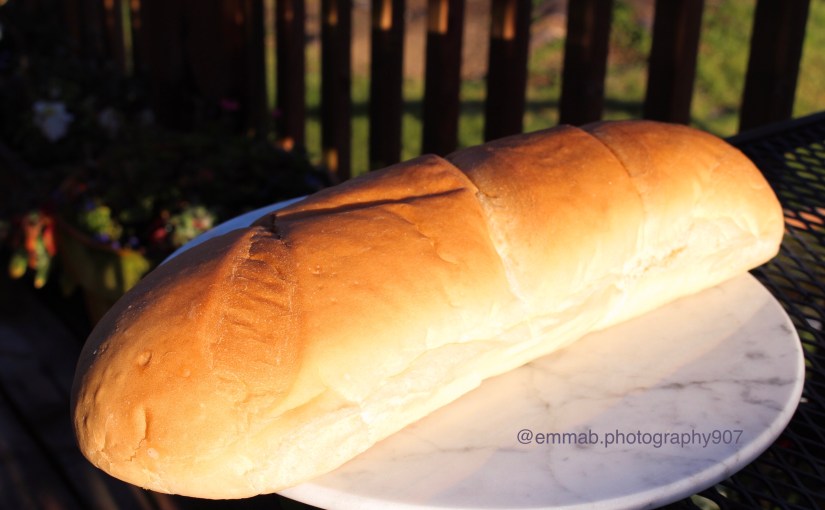
            And there knelt 5-year-old John, who an hour earlier, had crammed into his mouth a leftover piece of dirty, stale croissant that he’d found on the floor of the backseat of the Suburban.  And had become upset when that bread was refused him.  Now with his hands on the rail, he was waiting eagerly for the pastor to give him the bread.  And say the blessing.  Reminding him of the promise.  Which he probably doesn’t even understand.  But it’s a promise to him, nonetheless.  John knelt, eagerly waiting, hands outstretched, for the bread.  The new bread, that had been blessed on the altar. The Bread, given specially for John.

            And I knelt a few feet away, thinking about how often I’m in such a hurry to grab what I can, thinking of me, wanting whatever’s available.  Really, just stale, dirty crumbs from the floor of the car. Instead of waiting for the blessings God has in mind for me.  Waiting for what’s been promised.  For what’s been blessed.  Like the Bread of Life.  Given for me.
Hold Back the Tide

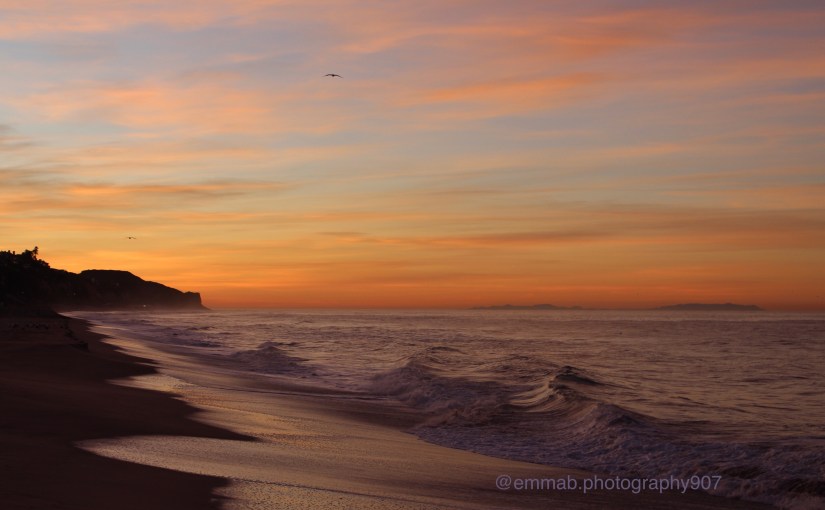
            It was a lovely spring morning.  The blue sky was mirrored in the otherwise teal, glacial-fed waters.  A slight breeze carried the salty air to land. Seagulls coasted lazily on the breeze, searching for fish in the waters below.  And I stood in the middle of it all, gratefully lifting my face to the sun.

            After the sometimes violent storms of fall and winter, and an unusually wet early spring, mornings like this felt like an apology.  An apology which was readily accepted, with a quickly fading memory of winter.  Amazingly, the beach was deserted except for the kids and me on this glorious morning.

            The kids had spilled out of the car doors and scattered in as many different directions the moment we got there. As I breathed in the morning air and wandered peacefully along the water line, they raced.  Kathryn, 9, challenged me to a rock-skipping competition.  Which I have always won, but the margin of victory is narrowing each time.  Benson, 5, delighted his little sisters by picking up the biggest beach rocks he could find and heaving them into the shallow water.  Each splash was followed by a brief dousing for the bystanders and squeals for more.  The little girls, Emma and Martha, each newly 3 years old, experimented in their new Winnie-the-Pooh shoes to see just how close they could come before the chilling water penetrated their shoes and socks.

            I stood at water’s edge for a moment, shielding my eyes from the sun, looking around in all directions, trying to breathe it all in.  The snow-covered mountains rising abruptly out of the water.  The beach, glistening with crushed quartz rock.  The ocean and sky, both so often forceful, now equally at peace.  I turned in full circle several times trying to memorize what I saw.  Then closed my eyes briefly to listen.  The gulls, gentle waves, and four of our five children laughing and yelling at each other.

            “Ben, get me some wood, fast.  Let’s build a dam!” Kathryn hollered, interrupting my thoughts.

           “All right, Ka’hryn!” came his eager response.

            I opened my eyes and looked down at the sand.  The tide was seeping in quickly.  High tide was still an hour away.  I looked down at my feet, predicting how many minutes I could remain exactly where I stood until, like Emmy and Marthy, the chilling cold would penetrate my shoes and socks.

            “Here’s a really big one!” Ben yelled enthusiastically as he dragged an old two-by-four over to where his sister was working.

            “Good job!  Go get more. Fast!”

            I watched them, smiling and shaking my head.  “You know,” I started to say.  And stopped.  They probably didn’t need my input on their dam construction.  They would find out soon enough on their own that it took a lot more than driftwood to hold back the tide.

            Marthy and Emmy, too, started to gather stray pieces of wood, sticks and small branches.  Laughing, and jabbering, they carried or dragged the pieces over to the “dam”.

            It’s not very often that I find myself with time enough to stand and watch the tide go in or out.  I notice when it’s high, or low.  But very rarely have I stood on the beach at water’s edge and watched it seep and spiral it’s way up the beach.  It runs, and swirls into every indentation on the beach, growing as it goes.  It seems harmless enough as it dribbles into cracks in the rocks.  Easy enough to dam, one would think.  Just little dribbles.  With the weight of the ocean behind them.

            “I need more!  I need more!” came the excited cry from Kathryn.

            “I got this great big one!” was the equally excited call from her little brother as he dragged a tree limb across the beach.  “This oughtta do the job,” he added confidently.

            “Good one, Ben!” came his sister’s praise.

            “Hey!  Hey!” Marthy pointed at the little rivulets of water seeping through the seemingly sturdy structure.

            “That’s okay, Marth.  It’s just little bits of water,” Ben reassured her.

            “I can’t believe how fast it’s coming in!” Kathryn yelled to me.

            “Yep.  It’s almost high tide,” I answered.  “How’s it going?”

            She looked at me and smiled, I think knowing the futility of their efforts.  I worked hard not to say anything.

            “It’s okay,” she said.  “Mom, do you think we can really stop the tide?”

            I smiled back.  Shrugged. Picked up another skipper and threw it.

            I walked down the beach a few yards listening to their conversations.  The excited tones of their talk.  They were working hard.  And all the while the water kept seeping and swirling, growing its way up the beach.

            “Our kids are building a dam to hold back the tide,” I mumbled to myself in thought as I walked.  And for a moment I thought of all the times in my own life that I have done the same. Working with every effort to stop the inevitable.  Pretending I could do it.  If I just tried hard enough.  And little set-backs weren’t really signs of futility.  Just little bits of water.

            I turned around again, watching them work.  They moved fast, together, as a team.  But each step they took quickly filled with water.  Finally, laughing and wet, they stepped back from their dam.

            “Hey Mom,” came the yell.  “We almost did it!”

            I smiled.  “Yep, you almost did,” I hollered back.

            As we piled back into the car I looked around once again at the mountains, the water, the sky, and the beach.  And at the now-abandoned dam project where our kids had spent the morning working.  Using driftwood to hold back the tide.

Pennies On My Path

When I was about 13 I was walking along a beach one day with my dad.  We were wandering our way down the beach looking for treasures–pretty rocks and shells. I lead the way, and Dad followed a few feet behind.

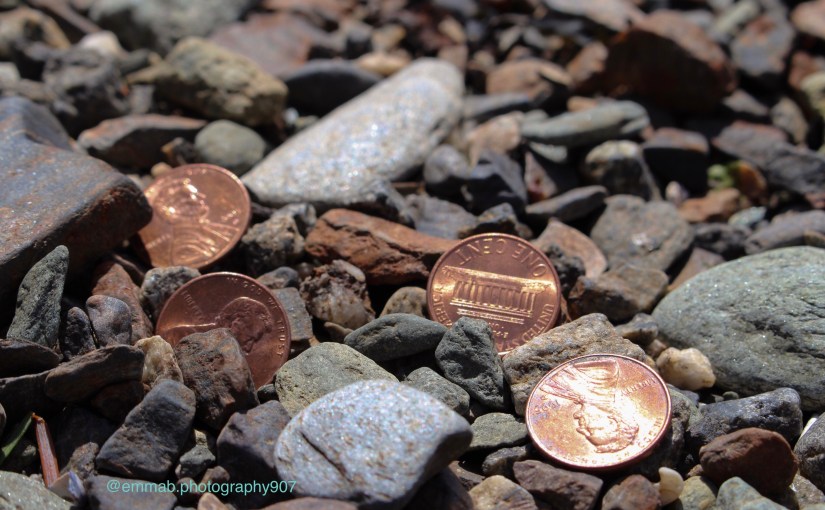
Midway into our walk I found a penny in the sand.  I picked it up, and held it up so Dad could see it.  A  minute or so later I found another penny.  And then another.  Pretty soon I was finding a penny about every 10 feet.

I started laughing. Why were there so many pennies on this particular beach? And how come I was the only one finding them?  Dad didn’t find any.  Where do you think they all came from, I asked.  With a smile on his face, he shrugged.

Pretty soon I wasn’t looking for pretty rocks and shells anymore.  I was looking for pennies.  And with each one I found I would turn back and hold it up in the air showing my dad.  See? Another one!

With each new discovery Dad would laugh, and share in my surprise.  I teased him that it was a good thing I was along on this walk since I was finding so much money.  He agreed, and I darted on ahead eager to look for more pennies.

It wasn’t until years later that I found out it was Dad who put those pennies on the beach that day.  As I walked along searching for treasures, he walked behind me quietly tossing pennies on the path for me to find.  With each discovery he would share in my surprise and delight.  And those that I walked by without discovering he would pick up as he strolled by so that he could toss them again.  And again.  Until I found them.

It’s one of the images from childhood that has stayed with me.  It became one of the images that frames my understanding of life,  and of God.

As I walk through life, wandering along looking for treasures, God is always with me, tossing pennies on my path.  When I find the pennies, He shares in my surprise and delight.  And those that I walk by without discovering He picks up as He strolls by so He can toss them in front of me again.  And again.

The following is a collection of a few of the pennies I have found, so far.