On Why The Cake Was Crunchy

            The twins, Martha and Emma, are 10 years old now and are beginning to learn how to bake.  Emma got an Easy-Bake Oven from Grandma at Christmas.  She was thrilled, and made a multitude of mini delectables. When we got the factory recall in the mail, she decided to “hurry up and finish the recipes.”  Probably sensing that the Easy-Bake Oven was not destined to remain in our house for long.

            Soon after, with newfound confidence in her baking abilities, and even greater confidence from the sheer presence of her twin in the kitchen, Emma decided that she and Martha were ready to graduate to real baking.

            Geoff and I were midway through replacing a screen door upstairs when Emma came up to ask if she could bake a cake.  A real cake.

            I hesitated.

            She immediately defaulted to her prepared arguments.  She whipped the cake mix from behind her back, explaining how the directions were pretty similar to the many 3-inch cakes she had already made in her oven.

            “I can do this, Mom,” she argued convincingly.

            Still I hesitated.  But when my mind momentarily reverted back to the screen, I gave a half-hearted okay.

            Seconds later, Martha appeared in our room asking about making a cake.  I explained that I had already given permission. She ran downstairs, ecstatic. Which should have tipped me off.

            She appeared a second time with a cake mix in each hand.  She asked which one I thought she ought to make.  I said that I thought Emma already had one.  And that’s when I finally got the picture. They were each planning on making a cake.  I explained that, no, I had given the okay for two bakers, one cake.  With only a minor argument, she returned downstairs to the kitchen to bake the cake with Emma.

            That evening, they asked if I’d make some frosting for their cake.  I agreed, and mixed up some frosting, leaving them to stir it, and frost their cake.

            It was later that night when they very proudly, and somewhat ceremoniously, served pieces of their cake to everyone in the family that I learned a little more about how the baking process had gone.

            Taking his first bite of his little sisters’ first real cake, 12-year-old Ben remarked enthusiastically, “Hey, this cake is crunchy!  It’s pretty good!  Mom’s cakes are never crunchy!”

            I was silently accepting the compliment, though I knew it wasn’t really meant that way.  And though I wasn’t having a piece of cake myself, I did find myself curious about the crunchiness.

            “Oh, that’s ‘cause I kinda heard the timer go off, but I thought I was just hearing it in my mind,” Emma offered.  “It had to go off for a couple of minutes before I said to myself, ‘Emma, is that really the buzzer, or am I just thinking it’s the buzzer?’  Then someone else said, ‘Hey Emma, isn’t that your cake buzzer?’  So I went to check and it really was the buzzer going off.  So it mighta got a little burned on the bottom.”

            I stared at her in fascination.  She looked over at me, checking to make sure that I’d heard her explanation.  And not wanting to draw attention to my fascination, I simply nodded silently, acknowledging that I’d heard.  And understood.  As much as anyone else could have possibly understood.  And wondered if ever there was a time when I heard a buzzer, but only in my head, until someone else told me that my buzzer was going off, and then I realized that it wasn’t just buzzing in my head.  Nope, I don’t think I’ve ever experienced that.

            “Hey Mom,” Martha interrupted my thought process.  “Up in the tall cupboard which one is the oil and which one is the vigenar?”

            “You mean vinegar?” I clarified.

            “Yeah,” she said, “which one is the vinegar?  Is it the round one, or the squarish one?”

            I explained that the round one was the vinegar.  Why?

            “Well, I think when I was puttin’ the oil in I might’a accidentally put vigenar in instead.  I wasn’t sure which one was oil.  Neither of them said ‘oil’ on them.  One started with a A and one started with a C.”

            That would be apple cider vinegar, and canola oil.  I explained that the C one would have been correct.

            “Oh,” she said.  Then paused to take another bite of cake.

            I sat watching her.  Waiting for her verdict.

            She swallowed.  “Then I’m pretty sure I put in the vigenar.”

            She smiled.  I nodded again.

            “So, maybe that’s why the cake is sorta crunchy,” she added.

            Hard to say.

            The kids all finished their pieces of cake.  Each complimenting the twins on the cake they had baked, and wondering when they would be making another.

            Marthy and Emmy, equally confident in their cake-baking abilities, and now with a success under their belts, basked in the appreciation of their older siblings.  And even though the Easy-Bake Oven was now in the garbage, having been recalled by the manufacturer, the girls were ready for the real world.

            And somewhere along the line, be it the buzzer which was mistaken for an auditory hallucination, or the last minute substitution of vinegar instead of oil, Martha and Emma had invented cake with a twist.  Even though the possibility still exists that the crunchiness came from something else entirely.  At this point in time, that’s all we know.  On why the cake was crunchy.

The Sound of Angel Choirs

I’ve never been much of a singer.  I sing in church.  But most of my singing is reserved for the car when I’m driving by myself.

I visited my mom this evening.  She’s 89, and has Alzheimer’s type dementia.  She has become increasingly non-verbal in the past year or so to the point where most days if she says, “Oh yeah,” or “Oh hey,” that’s pretty good communication for her.

She was just finishing her dinner this evening when I arrived.  I pulled up a chair next to her and rubbed her arm, and said, “Hi Mom.”  I reminded her that I am Ruth.  Her daughter.  Her favorite daughter.  To which she sometimes smiles, evidence of just the tiniest shred of humor. Still.  Tonight she didn’t respond to anything I said.  I gave her a kiss on the forehead, and started telling her about my day.

Mom was shaky tonight.  I’ve been told this is a side effect of some of her medicines. She was mumbling, but nothing I could understand.  Just random sounds.  The brain misfiring.

After a little while I asked if she wanted us to pray, and she said, “Well yeah.”  So we prayed.  We acknowledged the gift of salvation through Jesus, and the comforting breath of the Holy Spirit.  We thanked God for loving us and providing for us always.  Then we finished by saying the Lords’ Prayer together.  I spoke it.  Mom sat with her eyes closed, silently moving her lips.

After the Amen, she started to hum.  I didn’t recognize the tune.  I asked if she wanted us to sing together, and she said, “Yeah.”

I leaned in close, with  my forehead touching hers, and very softly—because I’ve never been much of a singer—I started to sing the Doxology.

Praise God from whom all blessings flow.

We’d sung it hundreds of times growing up.  At church functions and at home gatherings. Mom and Dad had sung it together sitting on the loveseat in their living room the night before Dad died.

Praise Him all creatures here below.

Mom had her eyes closed again.  The shaking was starting to subside.  She folded her hands over her chest, and hummed along.

Praise Him above ye heavenly hosts.

She was starting to harmonize.  I waited for a second, forcing back tears.  Waiting for my voice to return.

Praise Father, Son, and Holy Ghost.

When she took a deep breath, I started to sing it again.  Mom continued to hum along in harmony.  Still resting her head against mine.

And I knew in that moment that she was worshipping. Her brain is limited in what it can connect with.  But her spirit isn’t.  And right in this moment, she was worshipping.  I knew it.

I think we were on the fifth or sixth time through the verse when the realization hit me. That Mom’s singing, that our singing together, was being received right at that very moment.  By the One for whom it was intended.  As a gift of worship.  And even though it was just me singing quietly, and Mom humming along in harmony, I’m pretty sure that in Heaven it was being heard as the sound of angel choirs.  Singing praises.

It’ll Never Change

I took a possible-suicide call from a kid tonight.  We had just finished supper.  Geoff was sitting at the kitchen table visiting with me while I loaded the dishwasher. The kids had been sent off to various rooms of the house to pick up before heading upstairs to get into PJ’s. The phone rang.  Geoff answered it and handed it to me.

“Hi Ruth,” said the pleasant voice on the other end.

I said hello, and asked how everything was going.

There was a choking sound, and then the sobbing started.  I looked over at Geoff as I reached for the towel to dry my hands.  I raised my eyebrows at him, and waved as I headed into another room to talk in private. He stood up and assumed dish duty.

“What’s going on?” I asked into the phone.

“I’m in trouble.  Can you talk to me for a few minutes?”

“Are you safe right now?” I wanted to know.

“Yeah,” came the tentative answer.  And then she proceeded to tell me about a fight she’d just had with her family.

“It’s never going to change,” she cried.  “It’s never going to get any better.  Nothing is ever going to change.”

I listened for a while longer as she described the argument she’d had with her parents.  She described her frustration.  Her despair.

“I don’t know what to do.”

She had told me several weeks previously that she had been thinking about suicide.  She had planned how she could do it.  So I asked tonight if she was thinking about hurting herself.  She erupted in another round of sobbing.

“I don’t know,” she said.  “I just don’t know what to do anymore.  It’s never going to get any better.  So why keep trying when everything I do is wrong?  It’ll never change.”

We talked about how she could get through the rest of the night.  I asked all the questions for assessing suicide risk, and we made a plan for follow-up.  By the time we were done talking she’d calmed down quite a bit. She told me her plan for handling the rest of the evening.  She assured me that she wouldn’t hurt herself.  She would be okay.  She’d see me tomorrow.

I hung up the phone.  I could hear the commotion upstairs as the kids were getting ready for bed.  I took a moment to breathe.  Then I turned off the lights and headed upstairs.

“Who called?”  Kathryn, age ten, wanted to know.

“Just somebody who needed to talk,” I gave my typical work-related answer.

“Oh,” she said.

A short time later I said goodnight to the kids.  And tonight I held on to each one of them for just a few extra seconds.

“Mom,” Benson, age five, groaned when I requested another goodnight hug. “I already gived you one.”

I explained that tonight I was kind of feeling like I needed two.

He smiled.  Just playing hard to get.  And hugged me hard around the neck.

“Is that enough?” he asked exasperatedly.

The little girls, age three, took my request for extra hugs tonight as being some sort of game.  They didn’t really get it.  But were happy to oblige me with long, repeated goodnight hugs, and sticky kisses.

I climbed into bed for a few minutes with the older two girls, ages seven and ten. I crawled in under the covers between the two of them.  Anna’s head immediately came to rest on my shoulder.  Kathryn threw a leg across me.

“Mom,” Kathryn asked, “is that person who called tonight gonna be okay?”

I said that I thought the person would be just fine.

She didn’t say any more.  The three of us laid together quietly for a few minutes, snuggling.  I was thinking about the kid who’d called tonight. Praying that she would find her way through the night, and the weeks and months ahead.  And thinking about our own kids.

We’re not far away from the time when they’re going to feel a lot of the things that young girl is feeling tonight.  They’ll hit their teen years and likely struggle with feeling stupid, hopeless, ugly, frustrated, hurt, lonely, depressed.  They’ll wrestle with whether they can trust their parents enough to let us know how they’re feeling.  And at the same time, they’ll probably resent us for being so intrusive.  They’ll need to pull away from us.  And find their own way.

And as they move through that whole phase of their lives, I’ll still just be me. Mom.  Wanting extra rounds of goodnight hugs on nights when work gets a little too hard for me.  And wanting to snuggle with them for just a few minutes more, just one more time. I’ll miss the heads leaning on my shoulders, and the legs thrown across me.  The hugs that actually hurt sometimes.  And the little bodies that meld into mine when they hug.

But for tonight I got all those things.

It’s funny, though.  The kid I spoke with on the phone tonight ached inside, thinking that nothing in life would ever change.  And here I am, aching, knowing that it will.

C – Thanks for letting me tell your story – R

Conversations From the Tub

Martha and Emma, our twins, are five years old now. Five years of watching them grow together into two very different, independent little people.

When they were tiny infants they slept together in a basket.  They wouldn’t sleep, or wouldn’t stay asleep, unless they were touching each other.  More often than not, when we’d wake to check on them they would be lying face-to-face sucking on each other’s noses and chins.

When they got a little bigger we moved them into a crib.  One crib.  They still wouldn’t sleep unless they were touching each other.  We took photos of them sleeping in their crib together, limbs interwoven, sprawling across each other, often holding hands.

At age five they still sleep together.  Now in a double bed.  And when we go in to check on them they are usually curled up around each other, or sprawled with their legs overlapping each other.

But during the last few months, they’ve started to fuss with us at bedtime.  They’ll complain about having to go to bed so early when no one else in our family is going to bed yet.  Emma will ask why it is that she always has to go to bed with Martha.  Why can’t she wait and go to bed when 7-year-old Benson goes to bed?  Martha will kick at Emma once they’re in bed.  Upset that Emma is putting her feet on Martha.

“Martha, scoot over,” Emma will whine.

“Emma, no feet.  No feet,” Martha will fuss.

The big word lately has been, “Alone.”  Alone, accent on the second syllable.  It’s said territorially, almost as a word of warning.  A-lone.  Proceed with caution.  A-lone.  Be advised.  A-lone.  As in, not with what’s-her-name.

“I want to go to Dad’s office.  Alone.”

“But I wanted to help you make lunch.  Alone.”

“Can I take my bath now?  Alone?”

“Mom, can you and me play?  Alone?”

There are days when their jockeying for position, for independence, is annoying and irritating.  When everything is “mine” or “first” or “alone.”  When the level of competitiveness over everything from who won in the race to finish their cereal first, to who is line leader as we walk down the block, exhausts me.  When my whole morning is shot if I forget at breakfast time that Emma had the Dalmatians cereal bowl yesterday and so it’s Martha’s turn today.

But sometimes right in the middle of those trying days, in the very middle of the chaos, there are moments.  Priceless moments that I try to grab hold of.

Tonight after dinner Martha asked if she could take a bath.  Then Emma asked if she, too, could have a bath. Alone.  Martha quickly clarified that her bath request had implied that it be alone.  I told them that there wasn’t that much time before bedtime, and that there wasn’t much hot water because I’d been washing laundry all day.  Alone.

Ignoring their complaints, I went into the bathroom and began running water in the tub.  I called to them to get their PJs and bring them into the bathroom.  A second later, after I dumped in the bubble bath, they both entered the bathroom, naked, carrying their PJs.  No further unhappiness was expressed at having to share the bath.

Five minutes later, as I was in the bedroom sorting another load of laundry, I heard them visiting and giggling in the tub.  They were playing with some washcloths.  Using them to trap and smother bubbles.

“You know what, Emma?” Martha asked. Then after the slightest pause she said, “I love you.”

“I love you, too, Martha,” came Emma’s immediate reply.

That having been said, they returned to their bubble game, and giggling.

I stopped sorting clothes.  And just stood for a second.  There are moments.  Priceless moments which wash over all of the fussing and arguing and chaos which occurs on a regular basis in our house.  But I have to pay close attention, or I’ll miss them, as they shoot past me without warning.  And I do try to pay attention.  Because sometimes those priceless moments are nothing more than overheard conversations from the bathtub.

Becoming Family

Joe came to live with our family the day before Halloween the year he was 12.  He came from a facility in Pennsylvania, flying across the country to Seattle, where Geoff and a couple of our kids met up with him.  Then north to Alaska.

Joe’s background was a painful one.  We’d been briefed on him to see if we thought he would fit in our family.  The more we learned of the chaos and abuse, the neglect and turmoil, the more amazing it seemed that this kid had come through all of it.

He’d first been institutionalized at age 3.  The next nine years were a confusion  of transfers from foster placements to residential placements. There was a brief interlude with some biological family.  But by age 12, Joe had essentially grown up in institutions.

The adjustment in coming across the country to our home was a tremendous one for Joe.  And for us. He was pretty easy-going, obviously bright, loved to read, and would gobble up whatever we fed him and always ask for more.  He never smiled, never laughed.  Whether due to the medications he was on, or the heaviness of his life, he had absolutely no affect.  No facial expressions.  At times more like a mannequin than a boy.

One of Joe’s frequent statements those first few months was, “I don’t know what it’s like being in a family.  I’ve never done this before.”  It wasn’t said as an excuse, so much.  It was a statement of confusion:  the rules changed midway through and I don’t know how to respond to this.

We would explain that this is what a family is like.  Families are messy.  People argue. They say mean, ugly things to each other and then expect it to be okay again a few minutes later.  It doesn’t mean they don’t want you around anymore. It means they really just wanted you off the computer so they could check something.

But Joe had never had those kind of rules before.  He’d never dealt with “normal” family arguments that flare up and fade all in a matter of minutes.  He’d always had staff available to resolve anything, and if the staff couldn’t resolve the conflict then someone would be removed.

It was a difficult adjustment.  At first Joe wouldn’t say what he wanted.  Or didn’t want.  So the other kids would roll right over the top of him, often.   Then he’d get angry and either threaten to run away, or kill himself, or kill someone else.  Still playing from the only hand he knew.

One night about four months after Joe had come to live with us our son Ben, who was 13 at the time, had a friend over.  Ben and his friend were out in the driveway shooting baskets and we’d instructed the younger kids to leave them alone.  In a family our size, boundaries and personal space matter a whole lot. It’s okay to have a friend over and not have to share that friend with half a dozen siblings.

Joe came out to the living room and started getting his shoes on to go out and shoot baskets with the boys, even though he’d been told not to.  Martha and Emma, then both 11, were in the living room watching a movie.

“You can’t go outside,” Emma informed Joe, probably not in a nice tone.

He didn’t say anything, and just kept putting on his shoes.

“Joe, Mom and Dad said to leave the boys alone,” Martha added authoritatively.

He still didn’t respond.  Nor did he see that I had just come into the room from behind him.

“Joe!” both girls chorused, now irritated that he didn’t apparently think he needed to follow the rules.

And that’s when it happened.  Joe looked over at the girls, stuck out his tongue at them, and in a very ugly, taunting tone said, “Nyeeaahhhh.”

They were shocked.  He’d never done anything ugly like that before.  Also, they had an advantage over him.  They could see that I was standing a few feet behind him.

“Mom’s behind you, Stupid,” one of them taunted.

He turned to look at me.  Instantly worried.

I started to laugh.  I patted him on the back and said, “Joe, welcome to the family.  THAT’S how people in a family act.  You’re there, Buddy.”

“Huh?” he said, sure that I was somehow mocking him, or setting him up.

I told him that the girls were right, which he already knew.  He couldn’t go outside and join the boys. That it’s okay for someone to have time alone with a friend.  And it isn’t really okay to stick your tongue out and make taunting noises at each other. At the same time, that’s what siblings do.  They don’t threaten to run away for being told they can’t outside and shoot hoops. They don’t threaten to kill themselves because they’re being called on the carpet.  And they don’t threaten to kill someone else because a sibling butts in and tries to enforce the rules.  They just stick out their tongues and make ugly, taunting noises.  Or they yell, call names, threaten to tattle on, etc.

He didn’t really seem to get it at the time.  And I’m really not sure when it ever did really sink in for him.   I just know that eventually it did.

But that was a long time ago.  Joe probably doesn’t even remember that evening anymore.  He probably remembers his transition into the family as being a long, drawn-out progression.  He probably doesn’t remember the exact moment that it happened.

But I do. It was right there in the living room that evening.  That was the exact moment when Joe became family.

J—Thanks for letting me tell your story.–Love, Mom

I Need To Tell You Something

She came through the front door in tears, struggling out of her boots and snow pants.  I stopped what I’d been doing, and asked what was wrong.

“It’s just everything.  They’re not being nice to me,” she cried, finally having to sit to pull off a stubborn snow boot.

“And….,” she rubbed a red little hand across her face to stop a runny nose. “I need to tell you something I haven’t ever told anybody before.”

I set my computer aside, and patted on my lap for her to come sit.  All the while, wondering what this new disclosure was going to be.

Over the years, there have been so many times that I’ve heard that statement. I need to say this.  I’ve never told anybody this.  A preface to  a disclosure.   A warning. To the person, or to me, I’m never entirely sure which.  Be ready, because I’m going to say this now.  Then in a small voice, whether it’s a child or an adult, they go on to tell me of some horrific violation.  Or finally reveal some secret indiscretion which has been quietly eating at them, filling them with guilt and shame.

She came and plopped down on my lap.  Adjusting her position to fit in just right.  And the flood waters broke.

“At night I get out of my bed and look out the window at the sky.  I know my dad is a star now, but I don’t know which one.”

She erupted in another sob.

“And I should know.  You’d think I would know which one he is.  But I don’t.  And during the day I look up at the sky, but I don’t see his face anymore.”

I rubbed her back, and kissed her forehead.

She’ll be 8 years old next week.  She’s been part of our family for two years.  Her dad was murdered three months before she came to live with us.   As a 5-year-old her brain had to try to process having her dad killed.  And now, as an almost 8-year-old, she was sure she’d been doing it all wrong somehow.

We talked for a while.  I told her that I think when someone dies they don’t actually become a star.  I said I think they go to heaven, where God lets them keep an eye on their kids.

“How come?”  she asked.

I said that heaven is supposed to be a wonderful place.  And that as a parent, if I died and couldn’t see my kids anymore then heaven wouldn’t feel very wonderful to me.  So it made sense to me to think that God probably lets parents in heaven continue to keep an eye on their kids, checking in on them, continuing to love them.

She thought that made sense.  She snuggled in a little tighter, and began to breathe a little easier.

I said that I think most of the time when her dad checks in on her I bet he smiles. We talked about some of the specific things she does, and how her dad probably smiles when he sees her doing those things.

“And when you’re playing, and you’re being loud, and crazy, and laughing, I think your dad probably chuckles and tells other people in heaven, ‘That’s my little girl.  That little redhead over there.  She’s my little girl.’”

She smiled at that, and turned her head to look up at me for a minute.

I, of course, was in tears.  She wiped a tear off my cheek and then resumed her position.

“And at other times, when you’re doing something naughty,” I started.  And she turned to look at me again and smiled. “At those times, I think your dad’s probably saying, ‘Haida Sky, what are you doing?’”

She nodded, solemnly.  “That’s what he used to say to me when I was bad.”

We sat that way for a while.  Me, thinking about what an enormous burden this little girl has had to carry.  And how well she has carried it.  Her, breathing easier and seeming to relax as she thought more on how it works when someone you love dies.  Life, and death, and heaven.  And how to grow up here when your parent is there.  And how people are still in our lives, every single day, even after they die.

I whispered to her the reminder that I always want her to tell me the things she’s never told anyone ever before.

“Okay,” she said, sliding off my lap.  Then, still smiling, she shrugged back into her snow pants and pulled her boots on. And headed back outside.  To play.


H—Thanks for letting me tell this story.–Love, Mom

Music in our House

Music in our house has endured through numerous mediums, an array of abilities, and a frequent lack of enthusiasm at its existence.

            This morning, we were serenaded by the trombone upstairs blatting through “A Yellow Rose of Texas,” at the same time lines from “Thriller” squeaked out from the clarinet in the back room.  I took another sip of my coffee, and thought back to years earlier.

            Kathryn was three or four when we began to notice that she had an ability where lyrics were concerned.  Upon hearing a song, she knew the words.  The tune, on the other hand, often remained a mystery in her version.  Silently, we would smile encouragement, ever thankful for her ability with lyrics, which for years served as our prompt for unrecognizable tunes.

            Her dreams of ever becoming a singer were dashed brutally on the rocks of sisterhood when Anna, at about age two, began to speak.  “Dop hingin’ Ka’hryn” was one of her first statements, which she often repeated.  Translation: “Stop singing, Kathryn.”  Kathryn’s big-sister response was usually, “Anna, hush up.  I HAVE to practice.”

            By the following year we realized that Anna had an ability where melodies were concerned.  She didn’t know, or didn’t care, that there were words that went with each tune.  She made up her own.  But the tune was sung, or hummed, very well.  Her version of “This Old Man,” for example, was flawless. With lyrics to match the current situation, whatever it might be.

            “We are in the car.  We are going to the store.  Oh, I just think it should stop rainin’ soon.  Or we’re gonna get wet.  Or we’re gonna get wet.  We are at the store.  Now we’re gonna get wet.”

            The ride home would again be “This Old Man” with a twist.

 “We are goin’ home.  We are takin’ all our groceries home. Maggie (our dog) is gonna be happy to see us and our groceries.  Yeah. Da, da da, da, da, da, da.  We are home now.  Yes, we are.”

            Kathryn, whose patience is slim normally, would be pulling her hair out in clumps by this time.  “Anna, those aren’t the words!  Anna, stop it.  Those aren’t the words!”

            To which Anna’s calm reply would be, “I can sing whatever I want to, Ka’hryn.”

            The tune-versus-lyrics thing came to a head shortly thereafter.  Kathryn had learned a number of patriotic songs to sing for a school music program.  She practiced hard, and frequently.  The choir performance went wonderfully.  She belted out each song.  You couldn’t hear her.  But you could tell she knew all the words.

            Four-year-old Anna sat mesmerized during the performance.  And on the way home she began singing from the back seat of the car, “Oh, this lamp is your lamp.  This lamp is my lamp…”  Patriotism became a community property issue.

            Kathryn’s blood pressure peaked.  “Anna that’s not the song.  You can’t sing that song.  That’s my song.  Anna, you’re singing it wrong.  Anna. Anna!”

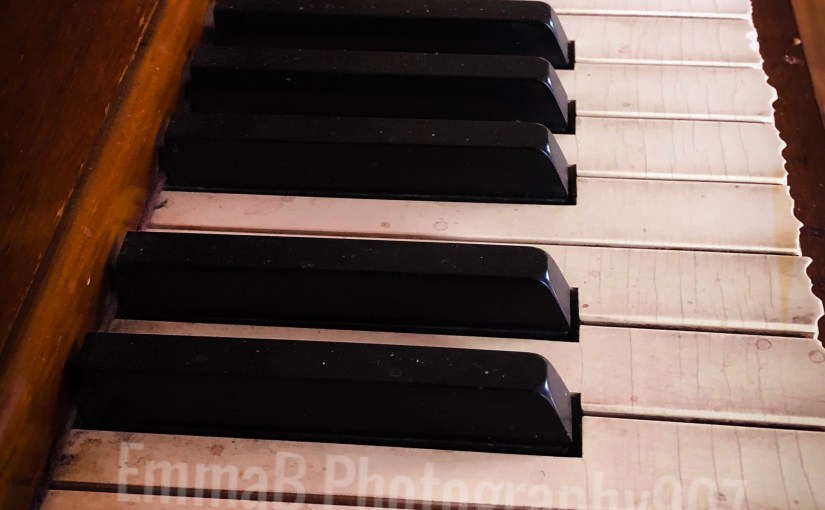
            So, with singing going so well, and bringing such joy and beauty into our home, we decided to start the kids on piano lessons.  Kathryn started first.  A couple years later she was joined by Anna.

            They both progressed well with their piano, though their styles remained completely different.  Kathryn was meticulous.  She didn’t have much style or flair in her pieces.  But they were played with accuracy.  She didn’t seem to really care one way or the other about piano.  It was just something she did.  And if she was going to do it, by golly she was going to do it accurately.

            Anna, on the other hand, loved the piano.  She’d hurry through her practicing so that she could play one of her own creations.  At age five, she began to write her own music.  I think she may be the only person ever to use a dice to determine what note should come next.  A three on the dice meant that the next note would be three keys up from the previous note. The next roll determined how many keys down the next note would be.  She was all style, all flair.  If she played a wrong note it was okay, “it can go that way.”

            Kathryn would try to correct Anna.  “No, Anna.  That’s not right.  It’s your left hand that plays that, not your right.  Your left hand is your bottom hand.”

            And Anna’s response would be, “Okay, Kaffryn.  But it sounds pretty this way, too.”

            One particular afternoon, Anna bashed her way through the normally pleasant piece, “Ode to Joy.”  She made lots of mistakes.  But not to be concerned by that, she kept the flow going.  Deeply moved by her own rendition.

Kathryn, who was doing math homework in the dining room at the time, was beside herself.

            “Agh!  Mom, she’s driving me nuts.  That’s not how ‘Ode to Joy’ goes.”

            Navigating carefully to avoid being pulled into the middle of this one, I think I just smiled and nodded.

            When Anna was finished, she quietly shut her music book.  And with an angelic smile, she sighed, “Oh, I just love that ‘Odd to Joy’.”

            This morning as the trombone practice upstairs, and the clarinet practice in the back room, wrapped up I got to thinking about all the years of music we’ve endured in our house.  Through numerous mediums, an array of abilities, and a frequent lack of enthusiasm at its existence, music in our house has hung on.  And it’s looking like it will continue to be present in our house for at least a few more years.  Whether we want it or not.  And it won’t necessarily be good music.

Coming to Life Again

Our daughter Kathryn was 8 years old when we gave her Kirsten.  Kirsten is an American Girl Doll.  I still remember Kathryn’s gasp when she opened the box on Christmas Eve to find Kirsten waiting inside.  And instantly Kirsten was alive.

Kathryn took her everywhere.  She tended to her hair meticulously.  We had gotten her a couple of outfits, and “getting Kirsten ready,” quickly became a frequent phrase in our home.

Over the next year or so we got Kirsten a few items of furniture.  A bed and dresser, some hangers for outfits, a table and chairs all made by a friend of ours.  Kirsten had her own area in the girls’ bedroom.

Kirsten also came with a set of books about her life in America, having immigrated from Sweden.  Kathryn was struggling to read in those days, and the Kirsten books became a wonderful opportunity to practice reading.  For months, once we had gotten the younger kids to bed at night, Kathryn would bring Kirsten out to the living room and snuggle with her while Kathryn and I took turns, each reading a page at a time, working our way through the Kirsten books. That’s when we discovered that not only were they best friends, but Kathryn and Kirsten also shared the same birthday.

Over the years, Kathryn grew up.  Kirsten did not.  Kirsten still mattered.  For a long time she stayed in a corner of the bedroom, with other special things.  But when high school and college years came, Kirsten was tucked away in a storage container.  Wrapped up in one of her blankets.  Safe.

A year ago we were going through a transition time in our home.  Kids were graduating from college, and others were transferring to colleges further from home.  We were cleaning out some storage areas in the house, encouraging the kids to take what they wanted and get rid of things they didn’t need or want anymore.

While the older kids were all busy going through boxes of memories, 10-y-o Kristall, our youngest at the time, wandered around bored.  Trying to help, trying to find something to do.  She was patient.  But bored.

Midway through the afternoon, Kathryn unpacked the Kirsten container. For a few minutes we both looked at Kirsten, and Kathryn picked up each of her outfits, studying them for a second.

“Mom? Do you think I could give Kirsten to Kristall?” she asked.  Then she reasoned aloud that she had wanted to keep Kirsten, but also realized that Kirsten should be loved.  Not just kept in a box for safekeeping.

I said I thought that was great idea.

I left the room while Kathryn called Kristall in to hand off her beloved Kirsten. I could have guessed how it went. Kathryn explaining to Kristall how much she loved Kirsten when she was Kristall’s age, and telling her a little bit about Kirsten.  Kristall carefully looking through Kirsten’s things, hanging on every word Kathryn said, smiling.  Feeling grown up, entrusted with a most valued friend.

It was a little later that afternoon when I ran downstairs to get something and stumbled upon the tea party.  Kristall had made tea in a small tea pot and had set up two cups and saucers.  She was pretending to spoon sugar into each cup as she visited quietly.  Everyone else was busy upstairs.  It was just the two of them in the dining room, Kristall and Kirsten.  Getting to know each other over a cup of tea.

Kristall was glowing.  She had her legs crossed and was deep in thought listening to Kirsten.  Trying out how it would be to be grown up and visiting with a new friend over tea.

Kirsten’s hair had been brushed, and the smudge cleaned off her cheek.  She was sitting in the chair next to Kristall, obviously sharing a story of some kind.

Unseen, I watched the two of them from the doorway for a minute or two before going back upstairs and telling Kathryn what was happening.  That downstairs, in the dining room, Kirsten was coming to life again.

Welcoming the Prodigal

The parable of the prodigal son has always been one of my favorite stories.  As a kid, I think I related more to the rebellious brother, the prodigal.  Not that I was rebellious, so much.  But I found comfort in the idea that no matter how selfishly I could possibly behave my parents would probably forgive me and welcome me home.  At least, the precedent for such a parental response had already been set.

As I grew, I started to relate more to the other son.  The good one.  The one who stays and keeps working in the fields, helping his father.  The one who, when the rebellious one returns, becomes resentful and angry.   His response was legitimate.  The circumstances were unfair.  And it’s not easy to forgive when it doesn’t seem that there were really any consequences.

But not until just a couple nights ago, did I ever relate to the father’s position in the story.

Our 14-year-old foster son  had been increasingly dissatisfied with some of the rules in our home.  Instead of expressing these frustrations to us, he frequently expressed them to our younger kids.  Stirring up the ranks.  Monday night, after not having slept really at all the night before, he started to escalate.  We alternated between confronting his questionable decision-making, and trying to give him space and opportunity to talk.  Ultimately, we didn’t respond the way he needed us to, and he ran away.

We notified the social workers, his counselor, and the police.  Then we sat around for quite a while, debriefing with the rest of the kids.

Our other kids were a mix of emotion.  They were relieved to have him gone, as his presence at times had been really trying.  They were saddened that he’d chosen to leave, and were worried about his safety.  All of this came out in a jumble of thoughts and explanations, concerns and criticisms, interrupting and spilling over the top of each other in no recognizable order.

We sat and listened.  We cautioned. We reminded.  We reassured.  We shared their worry, and tried to walk the line between validating their anger and also offering grace to this young man who in a moment’s impulse chose to walk away with nothing because it seemed like the best option at the time.

The next morning, when there was still no word, the kids’ reactions cemented more into anger.  They didn’t want him home.  He had rejected us.  He chose to leave.  So let him leave, they advised.  He swore at you and Dad, they argued.  None of us would ever do that.  He cussed you out and walked away.  I say he’s gone.

We listened, still trying  to walk that line between validation and grace.  And as the day progressed, and their anger overtook other emotions, something started nagging at me.  In the back of my mind.  There was  something in this series of events which was somehow familiar.

By late afternoon, our boy had been found. It became clear that he would be brought back home, which was his expressed desire.

Our other kids roared.

This was not acceptable.  He doesn’t deserve it.  He chose to leave, so let him leave.  I can’t believe you’re letting him come home when he talked to you and Dad like that, they raged.  And it was in their outrage that I finally heard the story clearly.

Our kids were voicing the outrage of the generations at this young rebellious one who had turned his back not so much on all of them, but on Geoff and me. He had disobeyed us.  Disrespected us.  That was the source of their anger.  That we would even allow him to come home was inconceivable.

The boy did come home that evening, looking frightened, humbled, and worn. We offered him a hot shower and a change of clothes, some food, and an opportunity to sit and talk.

We welcomed him home.  Not because he deserved it.  He didn’t. Not because we were rewarding bad behavior.  We weren’t. But because the precedent had already been set.  Long ago.


“And while he was still a long way off, his father saw him, and ran and embraced him.”  Luke 15:20. English Standard Version

Snickers

          We currently have three dogs.  They are great companions, and part of the family. We have never regretted their additions to our family.  But there was once another dog.  And I think I may always have regrets over that one.

            The kids came bursting through the front door on their way home from school that afternoon, with exciting news.

            “Mom!”

            “Hey Mom!”

            “Guess what followed us home?”

            Out on the front porch, pressed up against the door, stood a middle-aged, golden retriever-mix dog.  My enthusiasm didn’t quite match theirs.

            “He followed us, Mom!”

            “Yeah, can we keep him?”

            I tried to slow down the process a little.  Where did the dog come from?  It has a collar and a tag so it probably has an owner.  We should figure out how to contact the owner.

            They were visibly disappointed.  Mom, always the kill-joy.

            I said they could play with the dog outside.  But it wasn’t to be brought into the house.  And it wasn’t to be fed.

            They dropped their school bags and ran back outside.  Over the next couple of hours the dog played in the backyard with the kids.  Whenever I looked out, they were clearly having fun with it. And it was clearly enjoying being with them.

            When they came inside the dog laid down on the doormat on the back porch. By bedtime it was still there. And the kids had named him ‘Snickers’.

            Geoff and I talked about whether we ought to feed it something, and decided not to.

            “If it gets hungry enough, maybe it’ll head home to eat,” Geoff reasoned.

            It was with some surprise the next morning that I discovered Snickers still lying curled up on the doormat by the back door.  He stood up, happily wagging his tail and looking inquisitively at me as I opened the door.  I said good morning, and went to get him a dish of food.

            That afternoon, we called the vet and gave them the number on the dog tags. The vet gave us the name of the person who bought those tags.   It was a woman we knew, who happened to live just down the street from us.  We called her, and were told that it wasn’t her dog.  She’d lent that collar, with the old tags still on it, to a friend of her daughter’s who needed a collar for his dog.  She would get in touch with him.

            The kids were heartbroken.  Why’d we have to go and do that?  We explained that the dog had an owner who was probably worried about it.  But if Snickers was happy there, why didn’t he ever leave to try to find his way home?  Good question.

            I went out back and talked to Snickers.  He jumped up the second I opened the door, and stood waiting to find out what I wanted of him.  I patted his head, and told him that he was clearly a very good dog.  I said that our kids really wanted him to stay, but that we had figured we’d better try to contact his owners.  All the while, he stood beside me looking up at me with wizened eyes.

            The kids spent every possible moment out back playing with Snickers.  And when they came inside they lobbied us pretty hard to keep the dog.  He had chosen them.  Had chosen us.  There must be a reason.  He’s a good dog.  Please?

            The owners were contacted, and called our house.  They lived a few blocks away, and had had the dog tied up. But he’d gotten loose.  Could they come by later that evening and get him?

            It was with a bit of a heavy heart that I said they could.

            I went back to check on Snickers, and found him still curled up in his spot on the doormat at the back door.  I went out and told him the news.  His owners were on their way.  He just stared up at me with big brown eyes.  I’m pretty sure he understood what I was telling him.  And that he was telling me he’d chosen our family instead.  I patted his head some more.  Playing with his soft ears.  Then I leaned down and told him that he knew where we were.  If he needed to come back, just come.  I even promised that if he showed up again, we wouldn’t call the owners.  He’d be family then.  He stood next to me.  Staring up at me the whole time.

            That evening, the owners pulled up out front in a little beater car, blasting music.  A young man climbed out and ran up the back steps.

            “Dude!” he called to the dog.  “Come on, boy.”

            Snickers stood up.  And turned to look at me.  I tried to explain to the young man how he had shown up at our house.  But the man wasn’t listening.  He’d come for his dog.  He had his dog.  He was leaving.

            But the dog stayed.  On the back porch.  Right next to me.  The owner stopped halfway down the steps and turned to yell at the dog, telling him to come.

            But Snickers just looked up at me.

            I said something about being willing to buy him from the guy if he wanted to sell him.  He just laughed.  And yelled at the dog to come.  He started back up the steps to grab the dog by the collar.

            Snickers, by this time, had laid back down on the mat.  Curled up.  In his spot.

            The young owner took him by the collar, and hustled off down the steps toward the waiting car.

            At the car, the dog stopped again and looked back at me.  I looked him in the eye, hoping he’d understood that he was welcome here.  Anytime. Just show up.  And we wouldn’t call the owner next time.

            The owner put him in the car.  And as the car sped away from the curb, the last thing I saw of Snickers was his solemn eyes staring out the back window at me.  At his house.

            We all felt bad at his leaving.  None of us liked the look of the young owner.  We’d all hoped that Snickers would jump up happily when his owners arrived, so we wouldn’t feel so bad at his leaving us.  But that’s not how it went.  We talked about calling the woman down the street again, and letting her know that we’d buy the dog if the owner ever wanted to sell him.  And we told the kids that if they ever saw him on their way to and from school, or if he ever followed them again, we wouldn’t call to return him.  We even kind of suggested that if he wasn’t tied up, and they could coax him into following them, we’d keep him.

            The kids thought they saw him a couple times after that.  But he was always tied up.  He never followed them home again.  Never again showed up at our doorstep.

             But his brief stay with us will always be remembered.  For me, it was a lesson in understanding.  I don’t know how much that dog understood what I was telling him. But I do know that he understood my intent.  And I’m pretty sure I understood his.

            His time with us will also always be remembered as one of those times when doing what was right felt wrong.  And we all decided from then on that when someone chooses you as their home, as their family, or their sanctuary, you honor that.  No matter what.  We learned that one from Snickers.